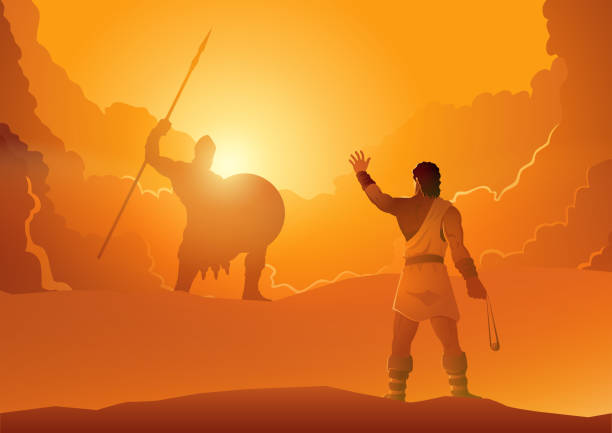
The Complete Story of David and Goliath
The story of David and Goliath is often reduced to a lesson about courage, but Scripture presents something far deeper. This account reveals God’s sovereignty, the nature of true faith, covenant representation, and how God saves His people through an unlikely deliverer. The full narrative unfolds in 1 Samuel 17 and must be understood within its historical, theological, and redemptive context.
The Historical and Covenant Context
Israel is at war with the Philistines, one of her most dangerous enemies. The armies face each other in the Valley of Elah, with a ravine between them (1 Samuel 17:1–3). This standoff reflects more than military tension. Israel is God’s covenant people, yet they are spiritually weak. King Saul, chosen for his height and strength, stands silent and afraid (1 Samuel 9:2; 1 Samuel 17:11).
Goliath emerges as the Philistine champion, a giant warrior from Gath, described in intimidating detail. His height, armor, and weapons emphasize human strength and military dominance (1 Samuel 17:4–7). His challenge is not merely to Israel’s army but to the God of Israel. He mocks them daily for forty days, inviting a representative battle where one man’s victory determines the fate of both nations (1 Samuel 17:8–10).
This form of warfare highlights representation. Whoever wins stands for his people. Israel’s fear reveals a lack of faith in God’s covenant promises (Deuteronomy 20:1).
Israel’s Fear and Saul’s Failure
The response of Israel is telling. “When Saul and all Israel heard those words of the Philistine, they were dismayed, and greatly afraid” (1 Samuel 17:11). Saul, anointed king and military leader, should have stepped forward. His silence exposes spiritual failure. Though outwardly impressive, Saul lacks trust in the Lord (1 Samuel 13:13–14).
Fear dominates because Israel evaluates the situation through human sight rather than God’s promises. They see Goliath’s size but forget God’s power (Numbers 13:33).
David’s Arrival and Spiritual Perspective
David enters the story not as a warrior but as a shepherd delivering food to his brothers (1 Samuel 17:17–20). While the soldiers discuss reward and survival, David hears Goliath’s blasphemy and reacts with holy indignation. His concern is not military defeat but God’s honor. “Who is this uncircumcised Philistine, that he should defy the armies of the living God?” (1 Samuel 17:26).
David’s language reveals covenant thinking. Circumcision represents belonging to God’s covenant. Goliath, though powerful, stands outside God’s promises. David measures the battle not by weapons, but by relationship with God (Genesis 17:10).
David’s Faith Explained
When questioned, David recounts God’s past faithfulness. He had faced lions and bears while protecting sheep, and God delivered him each time (1 Samuel 17:34–37). These experiences were not random. They were God’s preparation.
David’s confidence rests on God’s character, not his own ability. “The LORD that delivered me… He will deliver me out of the hand of this Philistine” (1 Samuel 17:37). Faith remembers God’s past work and trusts Him for present challenges (Psalm 77:11).
Saul’s Armor and Human Solutions
Saul offers his armor, symbolizing human strength and royal authority (1 Samuel 17:38–39). David refuses it, not because armor is sinful, but because it represents trust in human methods rather than God. David chooses familiar tools, a shepherd’s sling and stones, demonstrating reliance on God rather than appearances (Zechariah 4:6).
The Confrontation
Goliath mocks David’s youth and lack of armor, cursing him by his gods (1 Samuel 17:41–44). David responds with one of the clearest declarations of biblical faith. “I come to thee in the name of the LORD of hosts” (1 Samuel 17:45).
David explains the purpose of the battle. God will act so that all the earth may know that there is a God in Israel, and that victory does not come by sword or spear (1 Samuel 17:46–47). This is theology spoken on the battlefield.
The Victory
David runs toward the giant, slings a stone, and strikes Goliath in the forehead. The giant falls face down, defeated (1 Samuel 17:49). David then uses Goliath’s own sword to complete the victory (1 Samuel 17:51).
The outcome is decisive. The Philistines flee, and Israel pursues. One man’s victory becomes the nation’s deliverance. This reinforces the principle of representation established earlier (1 Samuel 17:52–53).
Christological and Redemptive Meaning
This story points beyond David to Christ. David acts as a representative champion, fighting on behalf of a fearful people. Israel did not defeat Goliath through effort; they were saved by David’s victory.
Jesus fulfills this pattern perfectly. Humanity stands powerless against sin and death, but Christ confronts the enemy on our behalf (Romans 5:18–19). Like David, Christ appears weak by worldly standards, yet triumphs through God’s power (1 Corinthians 1:27).
The battle belongs to the Lord, and salvation comes through His chosen deliverer (Exodus 14:14).
Application
The primary lesson is not “be brave like David” but trust God’s victory through His anointed king. Courage flows from confidence in God, not self-esteem. Believers face spiritual enemies, but victory rests in God’s power, not human strength (Ephesians 6:12).
Faith speaks truth when fear is loud. David’s words precede his victory, showing that belief comes before deliverance (2 Corinthians 4:13).
Summary
The story of David and Goliath reveals:
-
The danger of evaluating life through human sight (1 Samuel 17:11)
-
The power of covenant faith (1 Samuel 17:26)
-
God’s preference for humble instruments (1 Samuel 16:7)
-
Victory through a representative champion (1 Samuel 17:51)
-
A foreshadowing of Christ’s saving work (Romans 5:17)
God’s people do not overcome giants by becoming bigger themselves, but by trusting the God who already reigns over them. The battle is the Lord’s, and His victory becomes ours through faith (1 Samuel 17:47).





No comments yet. Be the first to share your thoughts!