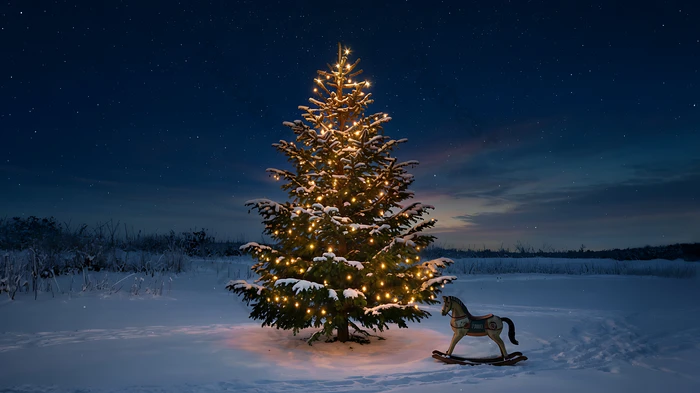
The Origins of the Christmas Tree
The story of the Christmas tree does not begin in a single place or moment. It is a tradition that can be followed like a trail through centuries of human history, moving from ancient winter customs, through medieval Christian worship, and finally into the living rooms and churches we know today. To understand the Christmas tree properly, it must be chased through time rather than reduced to a simple origin story.
Long before Christmas was celebrated, people living in the northern hemisphere faced long, dark winters. Trees lost their leaves, crops died, and the natural world appeared lifeless. Evergreens were different. They stayed green when everything else withered. Because of this, ancient cultures saw evergreen branches as symbols of life, hope, and endurance. Romans decorated homes with greenery during Saturnalia. Northern European tribes used fir branches in winter festivals. These practices were not Christmas traditions, but expressions of humanity’s instinctive hope that life would return after darkness.
As Christianity spread through Europe, it encountered these existing customs. Rather than simply erasing them, Christian leaders often redirected their meaning. One of the earliest Christian stories tied to trees comes from the eighth century missionary Boniface. According to tradition, Boniface cut down a massive oak sacred to pagan worship in Germany. When no divine punishment followed, he pointed to a nearby evergreen and used it as a teaching tool, explaining that its shape and enduring life could remind people of Christ and eternal life. Whether every detail of this account is exact or not, it reflects a broader truth. Christians began to see the evergreen not as a pagan object, but as a symbol that could be filled with biblical meaning.
By the Middle Ages, trees had entered Christian worship in a more visible way through church drama. On December 24, churches performed Paradise plays that retold the story of Adam and Eve and the promise of redemption. A key prop was the Paradise Tree, an evergreen decorated with apples representing the fall of humanity and white wafers representing Christ, the Redeemer. This tree stood as a visual sermon. Sin brought death, but Christ brought life. Over time, families began bringing versions of this tree into their homes, especially in German speaking regions.
By the sixteenth century, the Christmas tree had become a recognizable Christian household tradition in parts of Germany. Families decorated fir trees with apples, nuts, paper flowers, and candles. The decorations were not random. They symbolized God’s provision, the sweetness of salvation, and Christ as the light of the world. A popular story credits Martin Luther with adding candles to a tree after being inspired by starlight shining through branches, though the story cannot be proven. Even so, the idea fits the theology of the time. The tree was meant to point hearts upward toward Christ.
The tradition might have remained regional if not for the influence of the British royal family. In the nineteenth century, Queen Victoria and her husband Prince Albert, who was German, were illustrated celebrating Christmas with a decorated tree. The image spread rapidly through newspapers. Almost overnight, the Christmas tree became fashionable in England and then in America. What had once been a regional custom became an international symbol of Christmas.
Today, some people claim the Christmas tree is a purely pagan symbol that Christians mistakenly adopted. History does not support that claim. While ancient cultures used greenery in winter, the Christmas tree as it exists today developed within Christian worship and Christian homes. Its meaning was reshaped again and again to point toward Christ, eternal life, and redemption. Symbols do not remain frozen in time. They are defined by how they are used and what they are meant to communicate.
The Christmas tree stands today as a silent sermon. Its green branches remind believers of eternal life. Its lights proclaim that Christ is the light that shines in darkness. Its height lifts the eyes upward, away from earthly despair and toward heavenly hope. What began as a symbol of survival in winter became, through centuries of faith, a symbol of the Savior who brings life to a fallen world.
When viewed this way, the Christmas tree is not a compromise with paganism. It is a testimony to the Christian message transforming culture, filling old forms with new truth, and proclaiming that in Christ, life triumphs over darkness.


No comments yet. Be the first to share your thoughts!