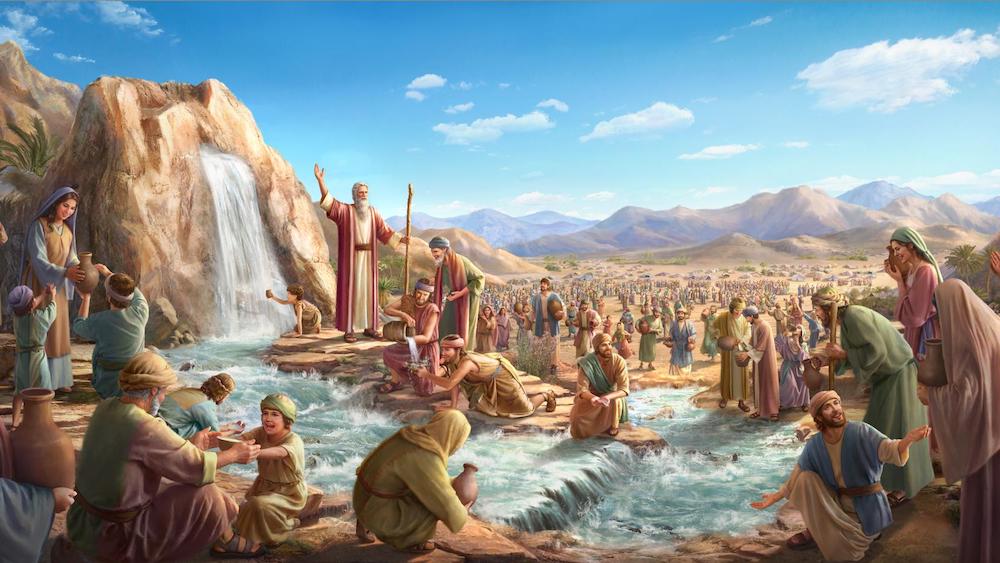
Why Did Moses Have to Only Speak to the Rock?
One of the scariest moments in the Old Testament is found in Numbers 20, when Moses strikes the rock instead of speaking to it. At first glance, the punishment seems severe. After years of faithful leadership, Moses is told he will not enter the Promised Land because of this act. Why did God command Moses to speak to the rock? Why did striking it matter so much?
To understand this, we must look carefully at the context, the symbolism, and the spiritual lesson behind the event.
The Background: Two Rocks, Two Moments
There are actually two separate incidents involving water from a rock.
The first is in Exodus 17. The people complain for water, and God commands Moses to strike the rock at Horeb. Moses obeys, and water flows out. This miracle demonstrates God’s provision and power.
The second occurs decades later in Numbers 20:8. The people complain again. This time, God gives a different command:
“Take the rod, and gather thou the assembly together, thou, and Aaron thy brother, and speak ye unto the rock before their eyes; and it shall give forth his water” (Numbers 20:8, KJV).
God clearly instructs Moses to speak to the rock, not strike it.
Instead, Moses says in frustration, “Hear now, ye rebels; must we fetch you water out of this rock?” Then he lifts his hand and strikes the rock twice with his rod (Numbers 20:10–11).
Water still comes out, but God responds:
“Because ye believed me not, to sanctify me in the eyes of the children of Israel, therefore ye shall not bring this congregation into the land which I have given them” (Numbers 20:12).
The Symbolism of the Rock
The rock was not just a source of water. It carried spiritual meaning.
The Apostle Paul writes:
“And did all drink the same spiritual drink: for they drank of that spiritual Rock that followed them: and that Rock was Christ” (1 Corinthians 10:4).
The first time, the rock was struck. This points forward to Christ being smitten for our sins. Jesus was struck once. He suffered once for sin. The sacrifice was complete.
“But this man, after he had offered one sacrifice for sins for ever, sat down on the right hand of God” (Hebrews 10:12).
The second time, the rock was not to be struck again. It was to be spoken to. Christ is not crucified repeatedly. After His sacrifice, believers approach Him by faith and prayer.
By striking the rock again, Moses distorted the picture. He misrepresented the holiness and redemptive plan of God before the people.
Moses’ Anger and Misrepresentation of God
Another key issue was Moses’ attitude.
Instead of calmly obeying, he spoke harshly: “Hear now, ye rebels.” He said, “Must we fetch you water,” which subtly shifted the focus from God’s provision to himself and Aaron.
God said Moses failed “to sanctify me in the eyes of the children of Israel” (Numbers 20:12). To sanctify means to treat as holy, to set apart properly. Moses’ anger gave the impression that God was irritated and impatient in the same way Moses was.
Leadership carries great responsibility. When leaders misrepresent God’s character, the consequences are serious.
James 3:1 reminds us that teachers receive stricter judgment. Moses, as the leader of Israel, was held to a higher standard.
The Importance of Exact Obedience
This event teaches that partial obedience is not full obedience.
Moses did not deny God. He did not reject the miracle. He even produced water. Yet he disobeyed the specific command.
God’s instructions are not suggestions. They are precise.
Deuteronomy 32:51 later explains the issue clearly: Moses trespassed against God and did not sanctify Him among the people.
This shows us that obedience is not just about outcomes. It is about honoring God exactly as He commands.
Why the Consequence Was So Serious
To human eyes, it seems harsh that Moses would be barred from entering the Promised Land. But consider several truths:
-
Moses had a unique calling and visibility.
-
The event distorted a powerful prophetic picture of Christ.
-
God was establishing His holiness before a new generation of Israelites.
Also, Moses was not abandoned. He later appears with Christ at the Transfiguration (Matthew 17:1–3). Though he did not enter Canaan, he entered something far greater, the presence of the Lord.
What This Means for Us Today
This story teaches several practical lessons:
1. Obedience must be precise.
We must follow God’s Word carefully, not adjusting it according to our emotions.
2. Anger can cloud obedience.
Even faithful servants can stumble when frustration takes control.
3. Christ was struck once.
The symbolism reminds us that Jesus’ sacrifice was complete. We now approach Him by faith, not by repeating the sacrifice.
4. Leaders must represent God accurately.
Our words and actions shape how others see Him.
Moses had to speak to the rock because God’s redemptive plan was being illustrated. The rock represented Christ. The first striking symbolized the cross. The second time required only a word, showing that after the finished work of Christ, we receive living water by faith.
The lesson is both humbling and hopeful. God is holy. His commands matter. Yet His provision still flowed even when His servant failed.
“And that Rock was Christ” (1 Corinthians 10:4).
May we learn to obey fully, speak faithfully, and honor the holiness of the Lord in all we do.




No comments yet. Be the first to share your thoughts!