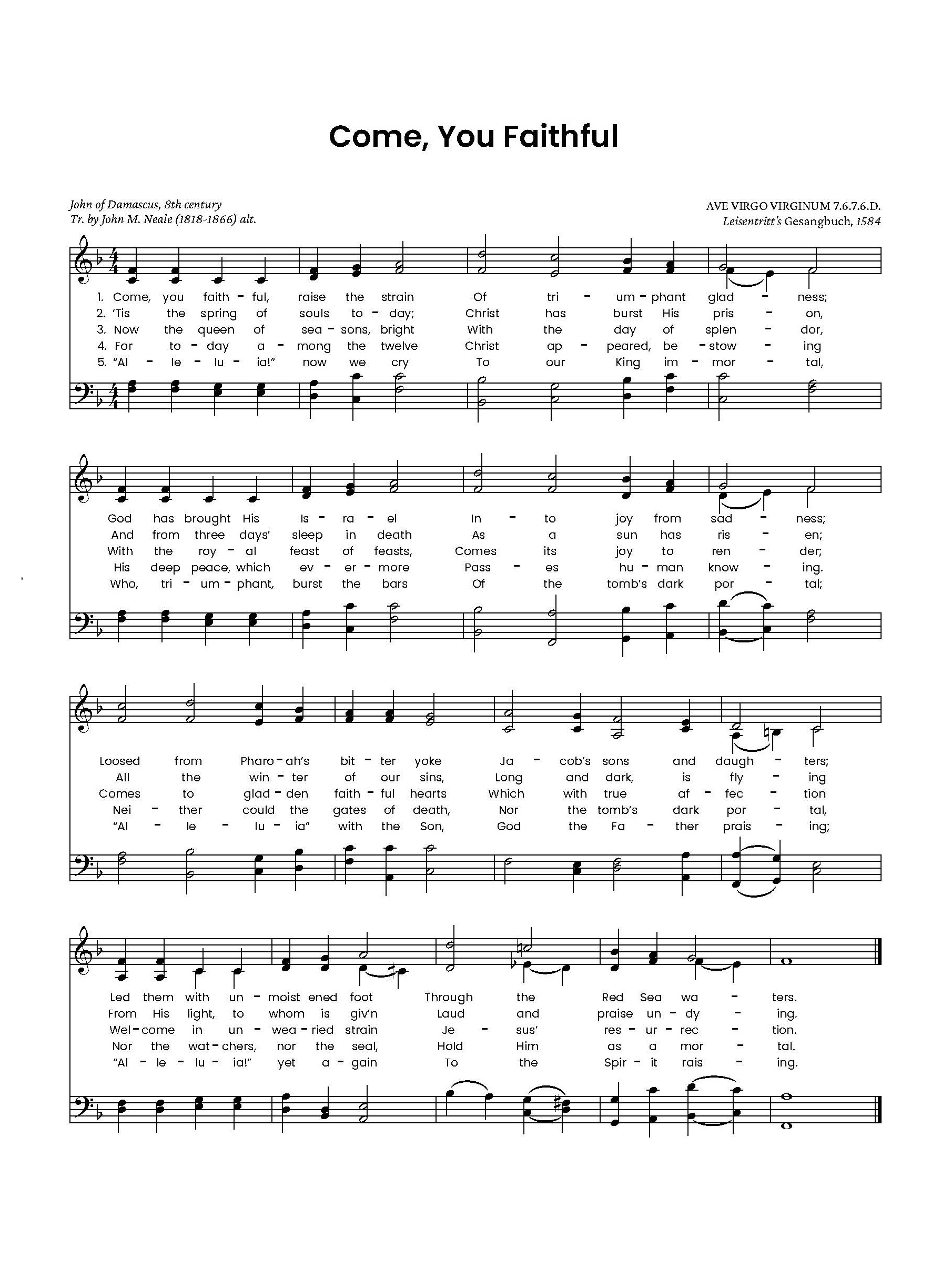
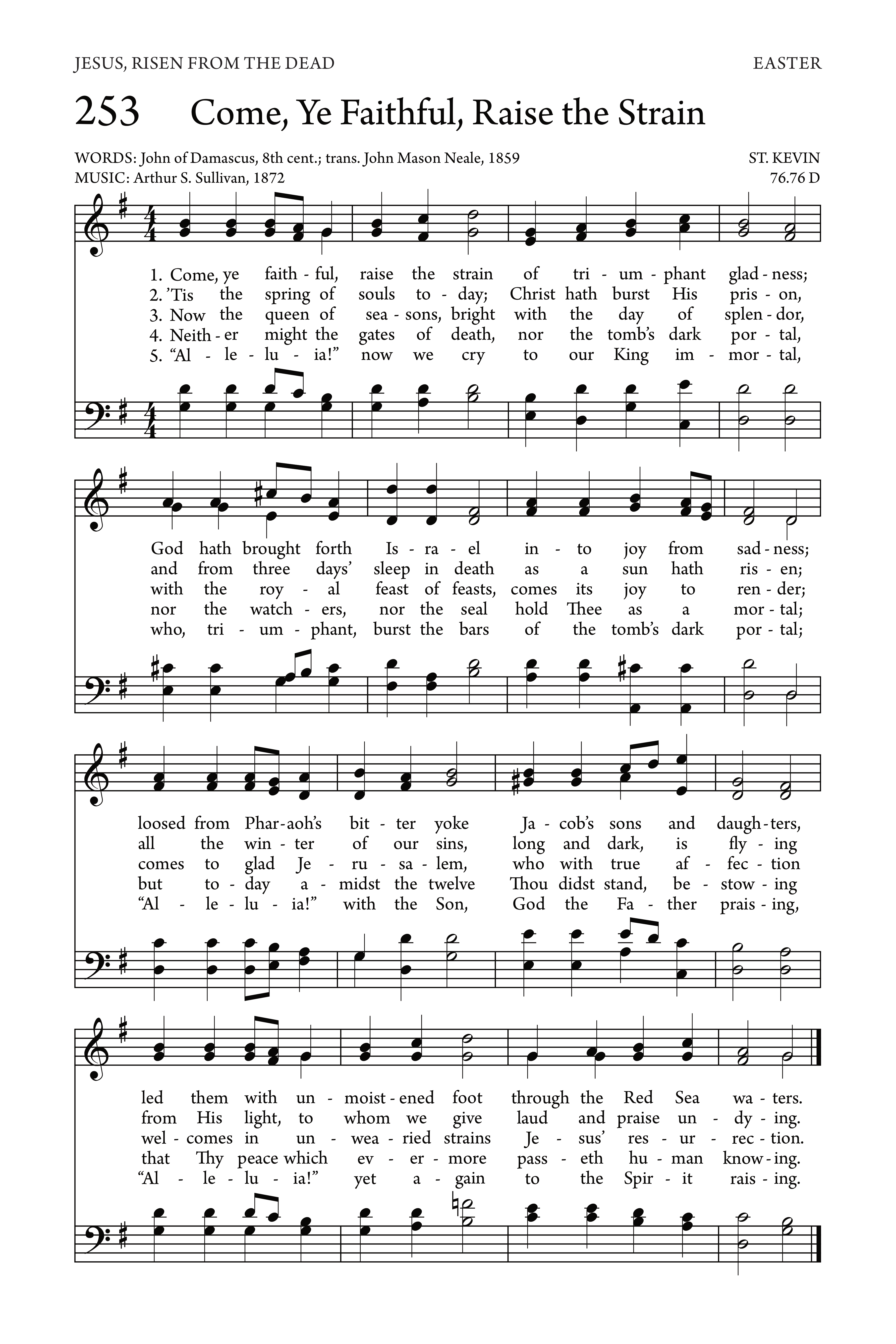
Come, You Faithful, Raise the Strain
By John of Damascus
Lyrics
Of triumphant gladness;
God has brought His Israel
Into joy from sadness;
Loosed from Pharoah’s bitter yoke
Jacob’s sons and daughters;
Led them with unmoistened foot
Through the Red Sea waters.
2 ‘Tis the spring of souls today;
Christ has burst His prison,
And from three days’ sleep in death
As a sun has risen;
All the winter of our sins,
Long and dark, is flying
From His light, to whom is giv’n
Laud and praise undying.
3 Now the queen of seasons, bright
With the day of splendor,
With the royal feast of feasts,
Comes its joy to render;
Comes to gladden faithful hearts
Which with true affection
Welcome in unwearied strain
Jesus’resurrection.
4 For today among the twelve
Christ appeared, be stowing
His deep peace, which evermore
Passes human knowing.
Neither could the gates of death,
Nor the tomb’s dark portal,
Nor the watchers, nor the seal,
Hold Him as a mortal.
5 “Alleluia!” now we cry
To our King immortal,
Who, triumphant, burst the bars
Of the tomb’s dark portal;
“Alleluia” with the Son,
God the Father praising;
“Alleluia!” yet again
To the Spirit raising.
Bible Reference
Exodus 14:21-31; 1 Corinthians 5:7; Revelation 15:3-4
About This Hymn
“Come, You Faithful, Raise the Strain” is one of the great resurrection hymns of the Christian church, written by John of Damascus, a theologian and hymn writer of the eighth century. Originally composed in Greek, the hymn was intended for Easter worship and celebrates Christ’s victory over death through rich biblical imagery drawn from both the Old and New Testaments. It has been translated into English in several forms, most notably by John Mason Neale in the nineteenth century, and appears in the Seventh-day Adventist Hymnal as number 170.
The hymn opens with a triumphant call to the faithful to lift their song of praise, echoing the joy of Israel after crossing the Red Sea. John of Damascus deliberately connects the Exodus deliverance with Christ’s resurrection, presenting both events as mighty acts of salvation accomplished by God. Just as Israel passed safely through the waters while their enemies were overthrown, so believers are reminded that Christ has passed through death and broken its power forever. This typological connection reflects the deep biblical theology of the early church.
A central theme of the hymn is liberation. Christ is proclaimed as the true Passover Lamb whose sacrifice brings freedom from sin and death. The hymn draws directly from the teaching of the Apostle Paul, who declares that Christ our Passover is sacrificed for us. The resurrection is not treated merely as a historical event, but as a present victory that shapes the life and hope of the believer. Death is no longer feared, because it has been defeated by Christ’s rising.
The tone of the hymn is joyful, confident, and majestic. It invites the whole church to rejoice together, proclaiming the triumph of Christ with strong, celebratory language. The hymn is especially suited to Easter services, yet its message remains meaningful whenever the church reflects on salvation, redemption, and new life in Christ.
“Come, You Faithful, Raise the Strain” continues to endure because it unites biblical history, doctrinal clarity, and heartfelt praise. It calls believers to remember God’s mighty acts, to rejoice in the risen Christ, and to live in the freedom secured by His victory over the grave.

📬 Subscribe to Our Devotional Updates
Receive weekly hymns, devotionals, and website features directly in your inbox.
Hymn Information

- Category: Hymn
- Author/Writer: John of Damascus (700)
- Added: December 14, 2025
- Last Updated: December 14, 2025
- Views: 19
MIDI File
Recent Blog Posts
-
 The Origins of the Christmas Tree
Dec 14, 2025 -

-

-
 How to Develop a Consistent Prayer Schedule
Dec 11, 2025 -
 How to Forgive Someone Who Deeply Hurt You
Dec 11, 2025
Visit Us on Social Media
Latest from X (Twitter)
Tweets by HymnalLibraryLatest from Facebook
Latest on YouTube
Daily Bible Verse
Disclaimer
The hymns, sheet music, MIDI files, and related content on this website are provided for educational and research purposes only.
- Public Domain: Many of the hymns featured here are in the public domain and may be freely used.
- Copyrighted Works: Some hymns may still be under copyright protection. Where applicable, permission has either been requested from the copyright owner, or the content is shared under the principles of fair use for educational purposes.
⚠️ Important Notice: If you wish to reproduce, distribute, or use any copyrighted hymn beyond personal study or educational use, you must obtain permission directly from the copyright holder. This website does not grant any rights for commercial use yet.
If there is any other question please address it to us in our Contact Page, for further assistance. Thank you for using the site. May God Bless You.