About Thomas á Kempis
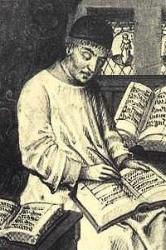
Thomas à Kempis (c. 1380 – 1471) was a Late Medieval German-Dutch canon regular, copyist, and mystic whose work served as the literary and theological peak of the Devotio Moderna (Modern Devotion) reform movement. Born Thomas Hemerken (meaning "Little Hammer," a nod to his father's trade as a blacksmith) in Kempen, Germany, he spent nearly his entire adult life behind the quiet cloister walls of Mount Saint Agnes in Zwolle, Netherlands.
While he successfully lived a life of deliberate obscurity, his instructions to novices yielded the most widely circulated, translated, and read book in Christian history outside of the Holy Bible: The Imitation of Christ.
The Landscape of the Devotio Moderna
To understand Thomas à Kempis, one must understand the late 14th-century religious landscape of the Low Countries. The Western Church was fractured by the Papal Schism, and monastic life was frequently viewed as worldly, overly intellectual, or mechanically ritualistic. In response, a layman named Geert Groote founded the Devotio Moderna movement, establishing the Brethren of the Common Life.
This movement bypassed heavy, abstract scholastic philosophy in favor of practical holiness, humble community life, daily introspection, and an intense, interior imitation of the life of Jesus. The Canons Regular of the Congregation of Windesheim became the formal monastic offshoot of this movement.
                    ┌──────────────────────────────────────┐
                    │    THE FLOW OF THE DEVOTIO MODERNA   │
                    └──────────────────┬──────────────────┘
                                       │
         ┌─────────────────────────────┴─────────────────────────────┐
         ▼                                                           ▼
 GEERT GROOTE'S REFORM                                      THE MONASTIC CLOISTER
Founded the Brethren of the Common Life;                    Thomas entered Mount St. Agnes in 1406,
emphasized humility, labor, and scriptural copy-work.       becoming a priest (1413) and sub-prior (1429).
In 1392, Thomas followed his older brother, Johann, to Deventer, a major hub for the movement, to attend a prominent Latin school. Deeply moved by the piety of the Brethren of the Common Life, Thomas decided to devote his life to their ideals. In 1406, he formally entered the recently established Monastery of Mount Saint Agnes (Agnetenberg) near Zwolle, where his brother had risen to serve as prior. He was ordained a priest in 1413 and was elected the sub-prior of the community in 1429.
The Life of a Copyist and Novice Master
Aside from a brief three-year period of exile due to an ecclesiastical dispute over the vacant See of Utrecht (1429–1432), Thomas spent an astonishing sixty-five years in the same monastery. His daily routine was structured around a celebrated personal motto that encapsulates his character:
"In omnibus requiem quaesivi, sed non inveni, nisi in hoexkens ende boexkens."
("I have sought peace everywhere, but I have found it not, save in nooks and in books.")
Thomas was a masterful, prolific copyist. He single-handedly hand-copied the entire Latin Bible at least four times (one beautiful five-volume set survives in Darmstadt, Germany), alongside countless works of Saint Augustine, Saint Bernard of Clairvaux, and other church fathers.
As sub-prior, his primary duty was the spiritual formation of the monastery's novices. To guide these young men through the psychological transition from the secular world to the interior life, Thomas compiled four distinct, practical instruction booklets between 1418 and 1427.
Landmark Masterpiece: The Imitation of Christ
Though initially circulated anonymously or attributed to other figures like Geert Groote or Saint Bernard, the 1441 autograph manuscript preserves these four booklets bound together under the title of the opening chapter: De Imitatione Christi (The Imitation of Christ).
Written in rhythmic, aphoristic Latin prose, the work is a systematic guide to stripping away the illusions of the world to cultivate an unshakeable inner peace through Christ.
Structural Framework of the Work
-
Book I (Admonitions Useful for the Spiritual Life): Focuses on clearing the mind of academic pride and vanity. It urges the soul to embrace humility, solitude, and a deep awareness of personal mortality.
-
Book II (Admonitions Leading to the Interior Life): Discusses the nature of interior peace, submission to the will of God, and the supreme theology of the "Royal Road of the Holy Cross."
-
Book III (Of Interior Consolation): Written as an extended, deeply moving mystical dialogue between Christ (the Master) and the human soul (the Disciple), handling doubt, temptation, and spiritual dryness.
-
Book IV (Concerning the Holy Sacrament): A liturgical, devotional meditation on the necessity and spiritual effects of the Holy Eucharist.
Key Aphorisms and Quotations
On Humility: "At the Day of Judgement we shall not be asked what we have read, but what we have done." (Book I, ch. 3)
On Providence: "For man proposes, but God disposes." (Book I, ch. 19)
On Transience: "O quam cito transit gloria mundi!" (Oh, how quickly the glory of the world passes away!) (Book I, ch. 3) — This specific line is widely credited as the direct origin of the historic papal coronation phrase: Sic transit gloria mundi.
The book was an absolute publishing phenomenon. Between 1500 and 1700 alone, over thirteen distinct English translations and paraphrases were issued. Sir Thomas More remarked that it was one of the three books every human being ought to own.
Remarkably, its emphasis on a direct, unmediated interior relationship with Christ allowed it to effortlessly cross the bitter battle lines of the Protestant Reformation and the Enlightenment, deeply influencing figures across the entire ideological spectrum:
| Era / Movement | Historical Figures Influenced | Nature of Impact |
| The Counter-Reformation | St. Ignatius of Loyola / St. Thérèse of Lisieux | Ignatius kept a copy constantly by his bed; Thérèse memorized vast chapters during her youth. |
| The Protestant Revival | John Wesley / John Newton | Wesley translated and published his own edited version for the early Methodist societies. |
| Philosophical / Literary | Søren Kierkegaard / Thomas Merton | Shaped Kierkegaard's concepts of individual Christian existence and Merton’s monastic journey. |
| Global Reformers | José Rizal / Swami Vivekananda | Rizal carried a copy to his execution; Vivekananda translated parts into Bengali, praising its universal asceticism. |
Beyond The Imitation of Christ, Thomas authored extensive spiritual biographies of the founding fathers of the Devotio Moderna (including Geert Groote and Floris Radewijns), a moving biography of the mystic Saint Lidwina of Schiedam, and several collections of monastery sermons (The Garden of Roses and The Valley of Lilies).
Thomas passed away peacefully on May 1, 1471, at approximately ninety years of age. A famous, dramatic legend later arose claiming that when his remains were exhumed centuries later for his canonization process, examiners discovered scratch marks on the inside of his coffin lid, leading to the theory that he had been accidentally buried alive and lost his composure in death, thereby disqualifying him from formal Catholic sainthood. However, historical researchers have found zero contemporary archival evidence to support either the premature burial or this theological disqualification.
Instead, Thomas achieved the ultimate, humble goal he set out for himself in his writings: his physical identity disappeared completely into the stone walls of Mount Saint Agnes, while his quiet sickroom instructions survived to provide a singing, praying blueprint of peace for millions of travelers looking for home.