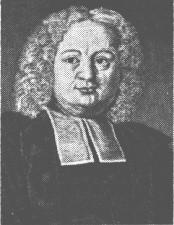
Benjamin Schmolck
Hymn writer & lyricist
About Benjamin Schmolck
Benjamin Schmolck (1672–1737)
Benjamin Schmolck was born on December 21, 1672, in Brauchitschdorf, Silesia (now Chrόstnik, Poland), the son of a Lutheran pastor. From an early age, he showed remarkable promise, entering the Gymnasium at Lauban in 1688 and completing five years of study there. His early preaching impressed local patrons enough that he received financial support to study theology at the University of Leipzig, where he came under the influence of scholars such as J. Olearius and J. B. Carpzov. Schmolck embraced a warm, practical Christianity that remained churchly in tone, avoiding the excesses of Pietism.
After completing his studies in 1697, Schmolck returned home to assist his father, and by 1701 he was ordained as his father’s assistant. In 1702, he married Anna Rosina Rehwald and was soon appointed diaconus at the Friedenskirche in Schweidnitz, Silesia, a church built under the strict conditions imposed by the Peace of Westphalia. Despite many restrictions and a dispersed parish, he faithfully ministered to his community. He rose through the church ranks, becoming archidiaconus in 1708, senior in 1712, and pastor primarius and inspector in 1714.
Schmolck’s life was marked by devotion and endurance. Exhaustive pastoral duties led to a stroke in 1730, which impaired his right hand. Over the next seven years, he endured further strokes and cataract operations, continuing to preach until he could no longer do so. He passed away on February 12, 1737.
Beyond his pastoral work, Schmolck gained widespread recognition for his hymns and devotional writings, composing around 900 hymns. His work expressed deep personal faith and love for Christ, and his most effective hymns are known for clear, flowing, memorable style suitable for both family and church use. While some of his later compositions tended toward elaborate expression, the first three collections remain treasured for their spiritual depth and poetic charm.
Several of Schmolck’s hymns have become well known in English, including "Der beste Freund ist in dem Himmel" ("A Faithful Friend Is Waiting Yonder"), "Die Woche geht zum Ende" ("The Week Draws Near Its Ending"), and "Meinen Jesum lass ich nicht" ("I’ll With Jesus Never Part"). His hymns address every aspect of Christian life: love for God, devotion to Christ, comfort in suffering, and hope in eternal life. Through these works, Schmolck’s legacy continues to inspire believers centuries after his death, reflecting a heart wholly dedicated to God and His church.
Hymns by Benjamin Schmolck
| # | Title | Year | Views | |
|---|---|---|---|---|
| 1 | Light of Light, Enlighten Me | 1731 | 311 | View |
| 2 | My Jesus, As Thou Wilt! | 1704 | 911 | View |
| 3 | Open Now Thy Gates of Beauty | 1704 | 286 | View |