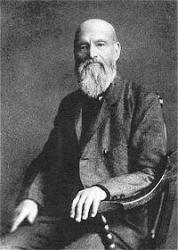
About Erastus Johnson
Erastus Johnson (1826–1909) was an American lay religious worker, hymn writer, and man of remarkably varied life experience. He was born on April 20, 1826, in a logging camp at Lincoln, Maine, and died on June 16, 1909, in Waltham, Massachusetts, later being buried in Jackson, Maine. His early education began at the Academy in Calais, Maine, which he entered at age fifteen, after which he taught school for several years before enrolling at Bangor Theological Seminary in preparation for ministry.
His plans for the ministry were interrupted by failing health and the threat of blindness, forcing him to abandon formal theological training. On medical advice, he undertook a sea voyage to California aboard the ship Gold Hunter. During the journey, a mutiny broke out near Cape Horn, and because Johnson was the only person aboard with any knowledge of navigation besides the captive officers, he was compelled to guide the vessel. He successfully navigated the ship to San Francisco, an extraordinary episode that stands out in his life story.
Despite arriving during the height of the California gold rush, Johnson did not pursue gold mining. Instead, he lived a diverse working life, serving as a rancher in California, a farmer in Washington State, and later spending about twenty years in the oil business in Pennsylvania. He eventually returned to farming in Maine before retiring in Massachusetts.
A devoted Methodist throughout his life, Johnson remained deeply engaged in religious work, particularly with the Young Men's Christian Association. He was known as a fluent speaker, a committed student of the Bible, and a man with modest musical ability. He published one volume of poems, though most of his writings were of personal or family interest rather than wide public recognition.
Erastus Johnson’s legacy lies not in widespread literary fame but in the combination of his adventurous life, steady faith, and lifelong dedication to Christian service.