About Erdmann Neumeister
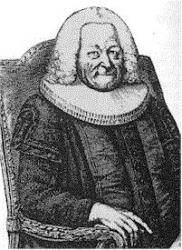
Erdmann Neumeister (1671–1756) was a German Lutheran pastor, hymn writer, and influential figure in early church music and hymnology. He was born on May 12, 1671, at Uechteritz near Weissenfels, the son of a schoolmaster and organist. He entered the University of Leipzig in 1689, earned his Master of Arts degree in 1695, and remained for a time as a university lecturer before entering pastoral ministry.
In 1697, Neumeister became assistant pastor at Bibra and was appointed pastor there the following year, also serving as assistant superintendent of the Eckartsberg district. In 1704, he was called to Weissenfels as tutor to the duke’s daughter and assistant court preacher, soon advancing to court preacher. After her death, he moved in 1706 to Sorau, where he served as senior court preacher, consistorial councillor, and superintendent. His final and longest appointment began in 1715, when he became pastor of St. James’s Church in Hamburg, where he remained until his death on August 18, 1756.
Neumeister was widely known in his time as an eloquent and forceful preacher, strongly committed to High Lutheran theology. He actively opposed the Pietists and Moravians, seeking to preserve what he saw as the doctrinal clarity and simplicity of the Lutheran faith. In addition to his theological work, he wrote one of the earliest historico-critical studies of German poetry and became a prolific author of church cantatas, playing a key role in shaping this musical form for Lutheran worship.
As a hymn writer, Neumeister was highly productive, composing over 650 hymns. Many of his early hymns became widely used and are still valued for their simplicity, strong scriptural foundation, poetic warmth, and depth of Christian experience. His hymns often contain clear and memorable expressions that have endured in devotional use. His works were published in collections such as Der Zugang zum Gnadenstuhle Jesu Christo (1705), Fünffache Kirchen-Andachten (1716), and Evangelischer Nachklang (1718), the latter including hymns written as conclusions to his sermons.
Several of his hymns were later translated into English, the most notable being “Jesus sinners doth receive” (from Jesus nimmt die Sünder an), which became widely used in Lutheran and other Protestant traditions. Through both his hymns and his cantatas, Erdmann Neumeister left a lasting influence on German church music and devotional life.