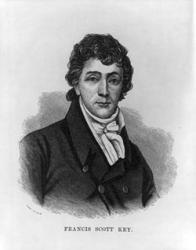
About Francis Scott Key
Francis Scott Key (1779–1843) was an American lawyer, poet, and devout Episcopalian best known for writing the lyrics of The Star-Spangled Banner, which later became the national anthem of the United States. Born in Frederick County, Maryland, he was educated at St. John’s College in Annapolis and went on to practice law in Washington, D.C. for many years. His legal career was distinguished, and he served as the United States District Attorney for the District of Columbia until his death. Key was also involved in public affairs and occasionally argued cases before the Supreme Court, while maintaining a strong commitment to his Christian faith and church life.
Key’s most famous contribution came during the War of 1812, when he witnessed the British bombardment of Fort McHenry in Baltimore Harbor. Having traveled under a flag of truce to secure the release of his friend Dr. William Beanes, Key found himself detained aboard a ship as the battle unfolded. Watching from a distance through the night, he saw that the American flag still stood after the bombardment. Deeply moved, he wrote the poem that would become The Star-Spangled Banner. The verses were later set to the tune Anacreon in Heaven by John Stafford Smith, and the song gradually gained popularity. It was adopted by the U.S. Navy in 1899, recommended for official use by President Woodrow Wilson in 1916, and finally declared the national anthem in 1931.
In addition to his patriotic work, Key also wrote several hymns that reflect his deep religious convictions. Among them are Before the Lord We Bow, a national thanksgiving hymn, and Lord, with Glowing Heart I’ll Praise Thee, which expresses gratitude for God’s pardon and peace. His poetry often carried spiritual themes and was later compiled and published in 1857. Though he was a slave owner for part of his life, Key opposed the slave trade and became involved in the American Colonization Society, even assisting some enslaved individuals in gaining freedom through legal representation. He remained active in the Episcopal Church, serving in roles that included lay leadership and ministry to the sick. Francis Scott Key died on January 11, 1843, in Baltimore, Maryland, leaving behind a legacy that blends national identity, legal service, and Christian devotion.