The Cities Jesus Visited: A Biblical Journey Through His Ministry
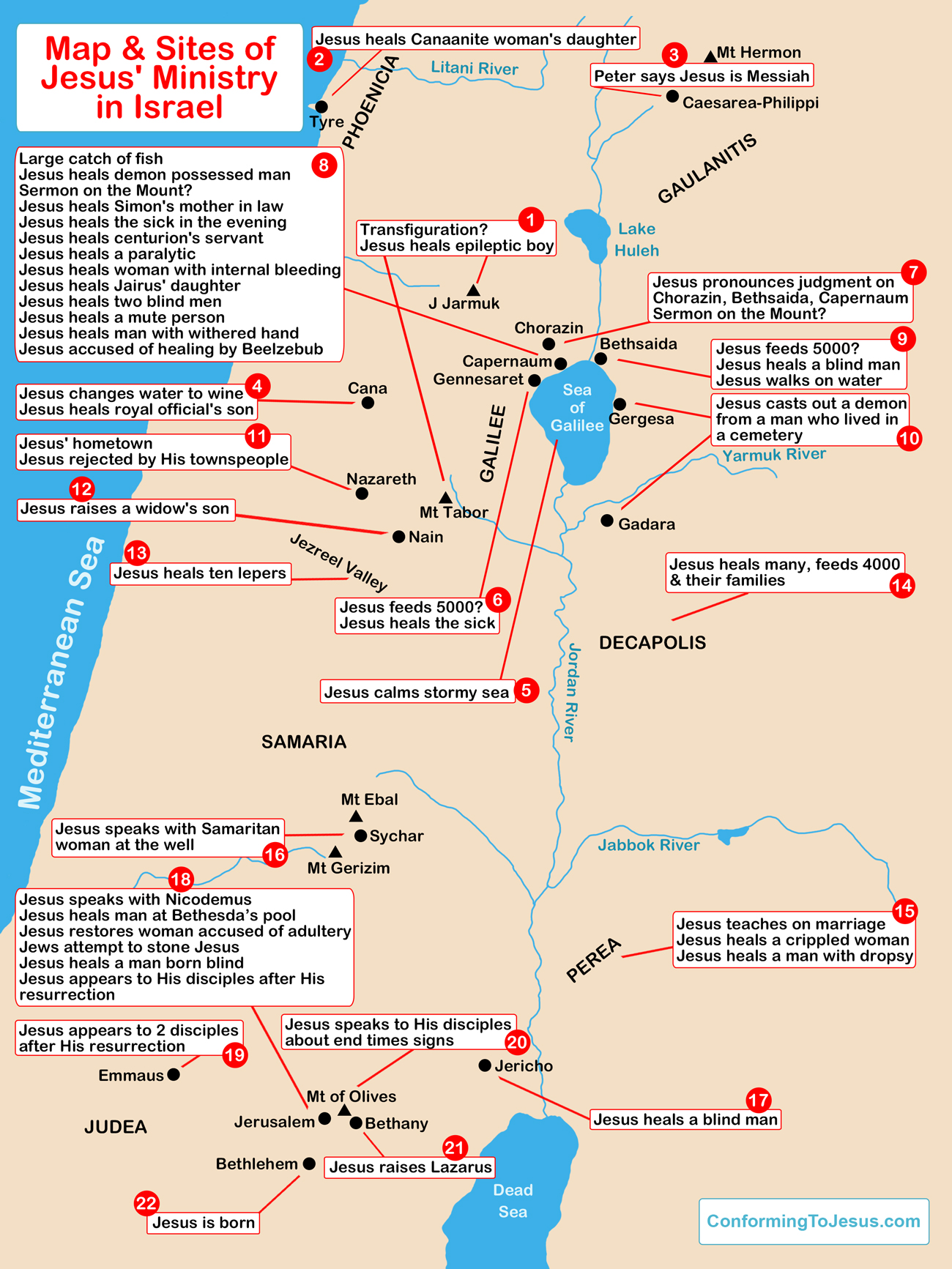
The Gospels consistently anchor His words and works in specific cities, villages, and regions, showing that God’s redemption entered ordinary human geography (Luke 1:1–4). These locations were not chosen at random. Each city reveals something about who Jesus is, how people responded to Him, and how the kingdom of God confronted culture, power, and unbelief.
Jesus was born in Bethlehem, a small town in Judea, fulfilling the prophecy that the Messiah would come from David’s city (Micah 5:2; Matthew 2:1). Bethlehem represents humility. The Savior entered the world quietly, not through royal courts but through a manger. This setting already signaled that God’s kingdom advances through lowliness rather than spectacle (Luke 2:7).
Though born in Bethlehem, Jesus grew up in Nazareth, a town of little reputation in Galilee. Nazareth shaped much of how people perceived Him. Skepticism followed Him because of its insignificance. Can anything good come out of Nazareth? (John 1:46). Jesus’ return to Nazareth during His ministry was marked by rejection, showing how familiarity can harden hearts against truth (Luke 4:16–30).
Capernaum became Jesus’ ministry base. Located along the Sea of Galilee, it was a bustling fishing and trade center. Here, Jesus taught in the synagogue, healed the sick, and cast out demons, displaying authority over sickness and spiritual forces (Mark 1:21–34). Despite witnessing miracles, the city later came under severe rebuke for unbelief (Matthew 11:23). Exposure to truth does not guarantee repentance (Hebrews 3:7–8).
Jesus traveled frequently around the Sea of Galilee, visiting towns such as Bethsaida and Chorazin. These cities experienced many miracles, yet largely remained unrepentant. Jesus pronounced woes upon them, emphasizing that accountability increases with revelation (Matthew 11:21). These warnings reveal that miracles alone cannot transform hearts without repentance.
Jesus visited Cana in Galilee, where He performed His first recorded miracle by turning water into wine (John 2:1–11). This sign revealed His glory quietly, within a family celebration, underscoring that His power was not meant to entertain crowds but to reveal divine identity to those who believed (John 2:11).
Nain, a small town, witnessed one of Jesus’ most compassionate miracles. There, He raised a widow’s son, restoring life and dignity to a grieving mother (Luke 7:11–15). This visit highlights Jesus’ concern for the marginalized and His authority over death itself.
Jesus often entered Samaria, crossing ethnic and religious boundaries avoided by others. In the city of Sychar, He spoke with a Samaritan woman, offering living water and revealing Himself as the Messiah (John 4:26). This encounter demonstrates that salvation is not restricted by geography, race, or social status (John 4:23).
Jerusalem stands at the center of Jesus’ story. He visited the city multiple times, particularly during Jewish feasts (John 2:13; John 5:1). Jerusalem represented religious authority and resistance. It was the city that killed the prophets and rejected the Messiah (Matthew 23:37). Jesus wept over it, foreseeing its destruction due to unbelief (Luke 19:41–44).
Bethany, located near Jerusalem, was a place of intimacy and friendship. Jesus often stayed there with Mary, Martha, and Lazarus (John 11:1). It was in Bethany that Jesus raised Lazarus from the dead, a miracle that accelerated the leaders’ resolve to kill Him (John 11:53). Bethany shows how closeness to Jesus brings both comfort and cost.
Jesus passed through Jericho on His final journey to Jerusalem. There, He healed blind Bartimaeus and called Zacchaeus, a despised tax collector, demonstrating that salvation seeks the outcast (Luke 19:1–10). Jericho represents grace entering places marked by spiritual barrenness.
Jesus also traveled beyond Jewish territories into regions such as Tyre and Sidon, ministering to Gentiles and revealing the global scope of His mission (Matthew 15:21–28). His interaction with the Syrophoenician woman shows that faith, not heritage, defines belonging in God’s kingdom.
Finally, Jesus was crucified outside Jerusalem at Golgotha. The city that rejected Him became the place where redemption was accomplished (John 19:17–18). After His resurrection, He appeared to disciples in Jerusalem before ascending from nearby Bethany (Luke 24:50–51).
Each location tells a story of how people encountered Christ and responded. Together, they reveal that God entered human history fully, walking real roads, engaging real communities, and calling all people everywhere to repentance and faith (Acts 17:30).




No comments yet. Be the first to share your thoughts!