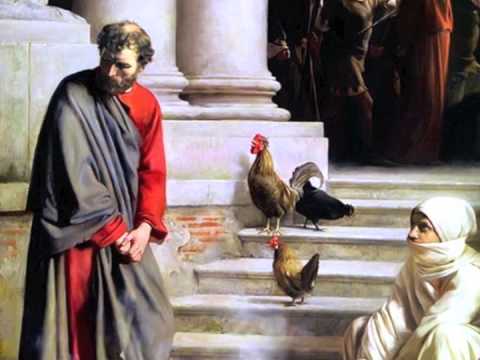
The Cock Crowing at Jesus’ Betrayal
One of the most discussed Gospel “contradictions” concerns how many times the cock crowed when Peter denied Jesus. A careful reading of all four Gospels shows no contradiction, but rather different levels of detail describing the same event.
Let us examine the texts closely, using Scripture to interpret Scripture.
The Statements of Jesus
Jesus predicted Peter’s denial during the Last Supper. The wording differs slightly across the Gospels.
Matthew
Jesus said unto him, Verily I say unto thee, That this night, before the cock crow, thou shalt deny me thrice.
Matthew 26:34 (KJV)
Luke
And he said, I tell thee, Peter, the cock shall not crow this day, before that thou shalt thrice deny that thou knowest me.
Luke 22:34 (KJV)
John
Jesus answered him, Wilt thou lay down thy life for my sake? Verily, verily, I say unto thee, The cock shall not crow, till thou hast denied me thrice.
John 13:38 (KJV)
Mark
And Jesus saith unto him, Verily I say unto thee, That this day, even in this night, before the cock crow twice, thou shalt deny me thrice.
Mark 14:30 (KJV)
At first glance, Mark seems different. He alone mentions two crowings.
The Fulfillment of the Prophecy
Now observe how each Gospel records the fulfillment.
Matthew
And immediately the cock crew.
Matthew 26:74 (KJV)
Luke
And immediately, while he yet spake, the cock crew.
Luke 22:60 (KJV)
John
Peter then denied again: and immediately the cock crew.
John 18:27 (KJV)
Mark
Mark gives the most detailed account:
And the cock crew.
Mark 14:68 (KJV)
After the second denial.
Then later:
And the second time the cock crew.
Mark 14:72 (KJV)
So Where Is the Alleged Contradiction?
The perceived contradiction arises from assuming that all writers must mention every detail. That assumption is not biblical and not how historical narrative works.
Mark records both crowings.
Matthew, Luke, and John record the decisive crowing that completed Jesus’ prediction.
Jesus’ core prophecy was this: Peter would deny Him three times before the night’s cock crowing period was completed.
Mark simply preserves additional precision.
Cultural and Historical Context
In first century Judea, “cock crow” was also a time reference, not only the sound of a rooster.
The Romans divided the night watches, and “cockcrow” referred to the period between about 3:00 and 6:00 a.m.
This explains why:
-
One crow could occur earlier in the night
-
The final crow marked the end of the watch
Mark highlights this nuance. The others summarize the event by referencing the final crow, which is the one that struck Peter’s conscience.
Jesus’ Words Were Precisely Fulfilled
Mark explicitly confirms fulfillment:
And Peter called to mind the word that Jesus said unto him, Before the cock crow twice, thou shalt deny me thrice.
Mark 14:72 (KJV)
There is no contradiction. Instead, there is harmony through complementary testimony.
This is similar to eyewitnesses describing the same event with different levels of detail. None contradict. One simply tells more.
Theological Significance
This moment is not merely about chronology. It reveals deep truths.
-
Christ’s omniscience
Jesus knew not only that Peter would fall, but how and when (John 2:25). -
Human weakness
Peter’s failure warns believers against self-confidence (1 Corinthians 10:12). -
Restorative grace
Jesus had already prayed for Peter’s restoration (Luke 22:31–32). -
Conviction leads to repentance
And Peter remembered the word of Jesus, and he went out, and wept bitterly.
Matthew 26:75 (KJV)
The cock crowing accounts are not contradictory, but complementary.
-
Mark records two crowings
-
The other Gospels focus on the final, decisive crow
-
All affirm Jesus’ prophecy and Peter’s threefold denial





No comments yet. Be the first to share your thoughts!