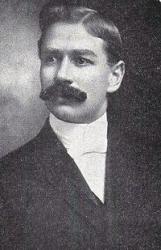
About Frederick A. Blom
Frederick A. Blom (1867–1926) was a Swedish-born hymn writer, minister, and evangelist whose life story is marked by both spiritual struggle and remarkable restoration. He was born on May 21, 1867, near Enköping, Sweden. As a young man, he emigrated to the United States in the 1890s, where he became actively involved in Christian ministry.
Blom initially joined the Salvation Army in Chicago, a movement known for its evangelistic zeal and outreach to the poor. He later pursued formal theological training at North Park College and Seminary and became a minister in the Evangelical Covenant Church, a denomination with strong Scandinavian roots. During this early phase of his ministry, Blom showed promise as both a preacher and a hymn writer, contributing to the spiritual life of immigrant communities.
However, his life took a tragic turn when he drifted away from the faith and the ministry. This decline eventually led to imprisonment, marking a dark chapter in his life. Yet this was not the end of his story. After his release, Blom experienced a deep spiritual awakening and renewal. His return to Christ was sincere and transformative, reflecting the biblical truth of restoration and grace, as seen in passages such as Luke 15:24, “For this my son was dead, and is alive again; he was lost, and is found.”
Following his conversion, Blom reentered Christian ministry with renewed conviction. He became a pastor in a Swedish Congregational Church in Pennsylvania, where he faithfully served and shared the message of redemption that he himself had experienced. His hymns, though few in number, reflect themes of divine love, grace, and personal salvation.
Among his best-known works is “Love Divine, So Great and Wondrous,” a hymn that exalts the greatness of Christ’s redeeming love. This hymn has been translated into multiple languages, including Spanish, showing its wide influence beyond English-speaking congregations.
In 1921, Blom returned to his homeland of Sweden, where he spent the final years of his life. He died shortly after his return, leaving behind a testimony that continues to encourage believers. His life stands as a powerful reminder that failure is not final and that God’s grace can restore and use those who return to Him in repentance and faith.