About Frederick William Faber
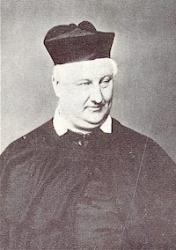
Frederick William Faber (1814–1863) was a prolific English hymn writer and theologian whose spiritual journey took him from the rigorous Calvinism of his youth to the heart of the Roman Catholic Church. Born at Calverley Vicarage in Yorkshire to a family of Huguenot descent, Faber was the son of Thomas Henry Faber, a lay secretary to the Bishop of Durham. His early education at Balliol College, Oxford, where he graduated in 1836, placed him at the center of the era's most intense theological debates. While at Oxford, he became a Fellow of University College and was ordained in the Church of England in 1839. During these formative years, he published several works in defense of Anglicanism, including volumes of poetry such as The Cherwell Water-lily (1840) and Sir Lancelot (1844).
A Radical Conversion and the Oratory
The turning point in Faber's life came through his association with John Henry Newman and the Oxford Movement. Influenced by Newman’s teachings, Faber followed him into the Roman Catholic Church in 1845. This transition marked a shift from his earlier prose defenses of the Church of England to a focus on Catholic devotional life. After a brief period in Staffordshire, Faber moved to London in 1849, where he established the "Oratorians" (Priests of the Congregation of St. Philip Neri) in King William Street. Under his leadership, the Oratory eventually moved to Brompton in 1854, where Faber continued to serve until his death in 1863.
The Evolution of a Catholic Hymnody
Faber’s most enduring legacy is his contribution to English hymnody. He observed that while Protestant traditions enjoyed the rich, emotional hymns of Charles Wesley and William Cowper, English Catholics lacked a similar collection of accessible, "Saxon-thought" songs for the common people. Despite his self-professed "ignorance of music," he set out to fill this void. His hymns evolved from a small pamphlet of eleven pieces for a school in 1849 to a massive collection of 150 works titled Hymns, published in 1862. His writing was characterized by a direct, simple, and often pathetic style designed to stir the hearts of the poor and the faithful alike.
"Faith of Our Fathers! Mary’s prayers / Shall win our country back to thee." — The original, overtly Catholic third stanza of one of Faber's most famous hymns.
Lasting Influence and Literary Output
By the end of his life, Faber had become one of the most prolific hymn writers of his century, with nearly 100 of his pieces in common use. His works, such as "My God, how wonderful Thou art," "O come and mourn with me awhile," and "Hark! hark, my soul," crossed denominational lines and became staples in both Catholic and Protestant circles. While some critics noted "glaring literary defects" like slipshod metre or elements of unreality, the sheer emotional fervour and simplicity of his verse ensured their longevity. Beyond his music, his later years were marked by influential prose works such as All for Jesus and Spiritual Conferences, cementing his status as a central figure in 19th-century devotional literature.