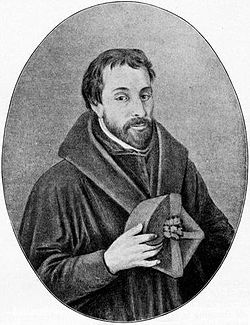
About Friedrich von Spee
Frederick William Faber (1814–1863) was a prolific English hymn writer and theologian whose spiritual journey took him from the rigorous Calvinism of his youth to the heart of the Roman Catholic Church. Born at Calverley Vicarage in Yorkshire to a family of Huguenot descent, Faber was the son of Thomas Henry Faber, a lay secretary to the Bishop of Durham. His early education at Balliol College, Oxford, where he graduated in 1836, placed him at the center of the era's most intense theological debates. While at Oxford, he became a Fellow of University College and was ordained in the Church of England in 1839. During these formative years, he published several works in defense of Anglicanism, including volumes of poetry such as The Cherwell Water-lily (1840) and Sir Lancelot (1844).
The turning point in Faber's life came through his association with John Henry Newman and the Oxford Movement. Influenced by Newman’s teachings, Faber followed him into the Roman Catholic Church in 1845. This transition marked a shift from his earlier prose defenses of the Church of England to a focus on Catholic devotional life. After a brief period in Staffordshire, Faber moved to London in 1849, where he established the "Oratorians" (Priests of the Congregation of St. Philip Neri) in King William Street. Under his leadership, the Oratory eventually moved to Brompton in 1854, where Faber continued to serve until his death in 1863.
Faber’s most enduring legacy is his contribution to English hymnody. He observed that while Protestant traditions enjoyed the rich, emotional hymns of Charles Wesley and William Cowper, English Catholics lacked a similar collection of accessible, "Saxon-thought" songs for the common people. Despite his self-professed "ignorance of music," he set out to fill this void. His hymns evolved from a small pamphlet of eleven pieces for a school in 1849 to a massive collection of 150 works titled Hymns, published in 1862. His writing was characterized by a direct, simple, and often pathetic style designed to stir the hearts of the poor and the faithful alike.
By the end of his life, Faber had become one of the most prolific hymn writers of his century, with nearly 100 of his pieces in common use. His works, such as "My God, how wonderful Thou art," "O come and mourn with me awhile," and "Hark! hark, my soul," crossed denominational lines and became staples in both Catholic and Protestant circles. While some critics noted "glaring literary defects" like slipshod metre or elements of unreality, the sheer emotional fervour and simplicity of his verse ensured their longevity. Beyond his music, his later years were marked by influential prose works such as All for Jesus and Spiritual Conferences, cementing his status as a central figure in 19th-century devotional literature.
Friedrich Rudolf Ludwig, Freiherr von Canitz (1654–1699), was a distinguished German diplomat and poet whose life was a rare blend of worldly prestige and profound Christian devotion. Born in Berlin on November 27, 1654, just months after his father’s death, Canitz was raised in an environment of high legal and political status. He pursued an elite education at the Universities of Leyden and Leipzig, followed by an extensive grand tour of Italy, France, England, and Holland between 1675 and 1677. This international exposure prepared him for a remarkable career in the service of the Great Elector, Frederick William of Brandenburg, whom he accompanied during military campaigns in Pomerania.
Canitz’s diplomatic trajectory was swift and successful. By 1680, he was appointed chief magistrate of Zossen and Trebbin, and he quickly rose through the ranks to become a counselor of the Court and Legation. Known for his skill in statecraft, he executed numerous sensitive missions under Frederick William and his successor, Frederick III. His contributions to the empire were so highly regarded that, in 1698, he was elevated to the dignity of a Baron by Emperor Leopold I. Despite the pressures of political life and his role as a privy counselor, Canitz maintained a disciplined internal spiritual life that would eventually define his literary legacy.
Although Canitz was a poet throughout his life, his work was not published until after his death in Berlin on August 11, 1699. His secular poems were often described as stilted and heavily modeled after Greek and Latin classics, yet they provided a necessary "healthy influence" that counteracted the coarseness prevalent in 17th-century German literature. However, his 24 spiritual poems—published anonymously in 1700 by Joachim Lange under the title Nebenstunden unterschiedener Gedichte (Leisure Hours of Various Poems)—are considered his finest achievements. These works reflected his personal piety and offered a counterbalance to the rigid formality of his diplomatic persona.
Of his religious works, the morning hymn "Seele du musst munter werden" (Come, my soul, thou must be waking) remains his most celebrated contribution to the church. The hymn is often cited as a mirror of his own life, particularly a poignant story from his final hours: as the dawn broke into his sickroom, he asked to be moved to the window to look at the rising sun one last time. He famously remarked that if the appearance of an earthly creation was so beautiful, the glory of the Creator would be unspeakable. Translated into English by figures such as H.J. Buckoll and Catherine Winkworth, his hymns have since been incorporated into major collections, securing his place in the history of international hymnody.
Friedrich von Spee (1591–1635) was a Jesuit priest professor, and the first major German Roman Catholic poet to emerge following the Reformation. Born at Kaiserswerth to a noble family, he was educated at the Jesuit gymnasium in Cologne before entering the order in 1610. Ordained around 1621, Spee’s early career was divided between teaching at the Jesuit college in Cologne and participating in the Counter-Reformation efforts in Paderborn. He was recognized by his contemporaries not only for his theological depth but for a remarkable mastery of rhythm and poetic metre that rivaled the reforms of Martin Opitz.
One of the most defining and harrowing chapters of Spee's life began in 1627 when he was summoned by the Bishop of Würzburg to act as a confessor to those accused of witchcraft. Within two years, he accompanied approximately 200 people of all ages and social ranks to the stake. Though bound by his role, Spee was secretly convinced of their innocence. This traumatic experience led him to anonymously publish his landmark work, Cautio Criminalis (1631), a powerful legal and moral argument against the cruelty and procedural flaws of the witch trials. The book is credited with playing a major role in bringing an end to the systemic burning of "witches" in Germany.
As a writer, Spee was noted for a "deeper and purer nature" than many of his peers. His poetry is characterized by an intense, almost romantic love for the natural world—finding God in the sights and sounds of the countryside, particularly during the spring and summer. His most significant literary achievement, Trutz Nachtigal (Defiance of the Nightingale), completed in 1634, showcased his ability to blend pastoral imagery with fervent religious warmth. While his work was sometimes criticized for being overly sentimental or for using "incongruous" dialogue in serious contexts, his mastery of German prosody influenced generations of Catholic hymnody.
Spee’s life was cut short by the very compassion that defined his career. While serving as a professor of Moral Theology in Trier, the city was stormed by Spanish troops in 1635. In the aftermath, a fever broke out among the wounded and the poor. While ministering to the sick in the hospitals, Spee contracted the infection and died on August 7, 1635, at the age of 44. Though his hymns were often deemed too subjective for formal public worship, they remained popular as processional songs for great festivals. His influence survives in English through translations of poems such as "Within a Garden's bound" and "The gloomy winter now is o'er."