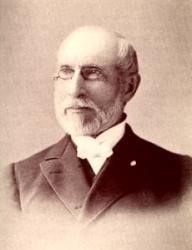
About George F. Root
George Frederick Root (1820–1895) was a monumental figure in 19th-century American music, serving as a composer, educator, and publisher. While he is deeply embedded in the history of hymnody, he is perhaps even better known as the "composer of the American Civil War" and a pioneer in the musical education of the masses.
Early Life and Apprenticeship
Born in Sheffield, Massachusetts, Root displayed an extraordinary innate musical talent, claiming that by age thirteen he could play as many instruments as he was years old. Despite skepticism from his community regarding music as a career, he moved to Boston in 1838 to work for A. N. Johnson. His rise was meteoric: within weeks, he was playing for prayer meetings and teaching pupils. During this time, he became a protégé of Lowell Mason, the "father of American music education," singing in Mason's celebrated choir and eventually assisting him in teaching music in Boston's public schools.
Career in New York and the "Normal" Movement
In 1845, Root moved to New York City to teach at the Abbott brothers' school for young ladies. His schedule was relentless, spanning multiple institutes and the Union Theological Seminary.
Root’s greatest contribution to pedagogy was the "Normal Musical Institute," which he originated in 1853. These were intensive summer training sessions for music teachers, featuring faculty like Mason, Thomas Hastings, and William Bradbury. These institutes became the gold standard for musical training in the United States, shaping the skills of thousands of teachers and composers.
The Civil War and "The Battle Cry of Freedom"
In 1860, Root moved to Chicago to co-found the publishing firm Root & Cady. When the Civil War broke out, Root channeled the national sentiment into song. His compositions became the literal soundtrack of the Union:
-
"The Battle Cry of Freedom": Perhaps his most famous work, sung by soldiers in camp and on the march.
-
"Tramp! Tramp! Tramp! (The Boys Are Marching)": A song of hope for Union prisoners.
-
"Just Before the Battle, Mother": A poignant reflection on the human cost of war.
Hymnody and Collaboration with Fanny Crosby
Though secular and patriotic songs brought him fame, Root was a prolific creator of sacred music. He is credited with discovering the lyrical talent of Fanny Crosby while he was teaching at the New York State Institution for the Blind. Together, they produced the popular cantata The Flower Queen.
Root composed the music for numerous "Gospel Songs" that became staples of the Sunday School movement and the revivals of Moody and Sankey. His most recognizable hymn tunes include:
-
"The Jewels" (When He Cometh): One of the most famous children's hymns in the world.
-
"Knocking, Knocking, Who is There?": A popular revival hymn.
-
"Why Do You Wait, Dear Brother?": A staple of invitation calls in evangelical services.
Later Years and Legacy
In 1872, the University of Chicago conferred upon him the degree of Doctor of Music. Despite losing a quarter of a million dollars in the Great Chicago Fire of 1871, Root persevered, continuing his work with John Church & Co. in Cincinnati. He published approximately 75 books and 200 sheet music songs over his lifetime.
Root died suddenly of heart failure on August 6, 1895, while summering in Maine. He is remembered as a man of "spotless integrity" who successfully bridged the gap between high-art music and the "simple songs for the people," ensuring that music was accessible to every American household and congregation.