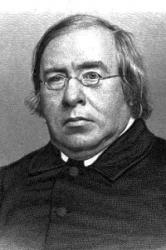
About George W. Bethune
George Washington Bethune (1805–1862) was a "very eminent divine" of the Reformed Dutch Church and a significant figure in 19th-century American religious and literary life. Born in New York City, Bethune was destined for a life of high academic and spiritual achievement. He graduated from Dickinson College in Carlisle, Pennsylvania, in 1822 and furthered his theological education at Princeton. His career was marked by a series of high-profile pastorates, moving from Rhinebeck, New York (1827), to Utica (1830), then to Philadelphia (1834), and finally to Brooklyn Heights (1850).
Bethune’s reputation was so formidable that he was offered—and notably declined—both the Chancellorship of New York University and the Provostship of the University of Pennsylvania. His refusal of these prestigious academic roles underscores his primary devotion to the pulpit and his literary pursuits, which spanned from theology and sermons to poetry and the study of female poets.
Bethune’s hymns often drew directly from his personal experiences and physical health struggles. His first and perhaps most beloved hymn, "Tossed upon life’s raging billow," was written in 1825 while he was on a voyage to the West Indies to recover his health. Known as a "Sailor’s Hymn," it captured the metaphor of spiritual endurance amidst the storms of life and quickly found its way into both American and English hymnals.
His literary output was prolific, including works such as:
-
The Fruits of the Spirit (1839)
-
Lays of Love & Faith (1847)
-
The British Female Poets (1848)
In his Lays of Love & Faith, Bethune showcased his versatility as a translator and songwriter. He provided a beautiful English rendering of Caesar Malan’s French hymn, "It is not death to die" (Non, ce n'est pas mourir). This specific hymn became a cornerstone of his personal faith; in a moving display of providence, he requested it be sung at his own funeral—a request that was honored after his remains were returned to New York from Italy for burial in Greenwood Cemetery.
Bethune was not merely a composer of original lyrics but also a bridge to the ancient world. His translation of a Greek evening hymn, "Light of the Immortal Father’s glory," is still cited for its liturgical value. Furthermore, his work extended into the burgeoning field of Sunday School education. In 1850, he published "Come, let us sing of Jesus," specifically tailored for children, and his Lays included several "Christmas Carols for Sunday School Children," such as "Joy and gladness, joy and gladness" and "We come, we come, with loud acclaim."
His influence crossed denominational lines, evidenced by his 1857 hymn "O Thou Who in Jordan didst bow Thy meek head," which was written for and extensively used by the Baptist community for adult baptism services. This adaptability speaks to Bethune's broad appeal as a writer who could capture the specific nuances of various Christian rites while maintaining a high standard of poetic excellence.
The conclusion of Bethune’s life was as poetic as it was sudden. In 1861, seeking relief from failing health, he traveled to Florence, Italy. On Saturday, April 27, 1862, he wrote a final poem in his portfolio titled "When time seems short and death is near," a work of deep anticipation and faith. The very next day, almost immediately after preaching a sermon in that historic city, he passed away.
His life was later chronicled by A. R. Van Nest in Life and Letters (1867), where several previously unpublished manuscripts were found. Among these was the Easter hymn "O Jesus, when I think of Thee." While some critics during his era considered certain of his later pieces to be of "no special merit," the enduring popularity of his translations and his poignant hymns on death and resignation, such as "Upon the well by Sychar’s gate," ensure that Dr. Bethune remains a respected name in the annals of American hymnody.