About George Wither
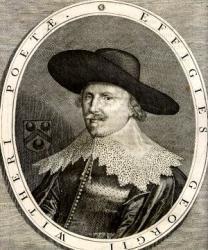
George Wither (1588–1667) stands as one of the most prolific and resilient figures in English literature. His life spanned a tumultuous century of civil war, plague, and political upheaval, all of which he documented with a "stinging and patriotically outspoken" pen. Born in Bentworth, Hampshire, Wither’s path to literary fame was far from linear. After being withdrawn from Magdalen College, Oxford, by a father who believed he had "learning enough," he narrowly escaped a life of "the plough" to find his true calling in London’s legal and literary circles.
Wither was a man of immense contradictions: a loyal subject who was repeatedly imprisoned by his kings, and a "pre-eminently Puritan poet" who remained a devoted son of the Church of England. His irrepressible nature was his greatest strength and his greatest liability; he was a man who, when unable to find a publisher, would literally set the types and print his own books to ensure his message reached the public.
Wither first captured the public’s attention, and the monarch's ire, with his 1613 work, Abuses Stript and Whipt. This collection of satirical poems was so pointed that King James I had him cast into the Marshalsea prison. Far from silencing him, the imprisonment only fueled his creativity. While behind bars, he wrote some of his "most delicious" verse, including The Shepherds Hunting.
He eventually secured his release through a clever dedication to the King, signing himself "his Majesty's most loyall Subiect, and yet Prisoner." This pattern of outspoken criticism followed by imprisonment became a recurring theme in his life, leading to later stays in Newgate and the Tower of London under both the monarchy and the Cromwellian Protectorate.
Wither’s political journey reflects the agonizing choices faced by many during the English Civil War. Initially a captain for King Charles I in the war against the Covenanters (1639), Wither eventually found the King’s "wrongheadedness" intolerable. In a profound act of conviction, he sold his ancestral estates to raise a troop of horse for the Parliamentarian cause.
Under the motto Pro Rege, Lege, Grege (For King, Law, and People), he rose to the rank of Major. Legend has it that when he was captured by Royalists, his life was saved only by a witty plea from fellow poet Sir John Denham, who joked that the King shouldn't hang Wither because "as long as he lives, no one will account [Denham] the worst poet in England." Wither survived to become a Major-General under Cromwell and a Justice of the Peace, though he was later "shamefully dealt with" during the Restoration.
Despite the "din of civil war," Wither produced a staggering body of sacred music and poetry. He was an avowed Christian poet, and while his polemics could be heated, his devotional works possess a rare, enduring beauty. His contributions to hymnology are found in several major collections:
-
The Hymnes and Songs of the Church (1623): Published with royal privilege, this was a landmark attempt to provide the English church with a robust liturgical songbook.
-
Hallelujah; or Britans Second Remembrancer (1641): A collection of "praisefull and poenitentiall Hymns" intended to cover every aspect of Christian life.
-
A Collection of Emblemes (1635): A favorite of the essayist Charles Lamb, this work combined moral verse with intricate illustrations.
Wither’s hymns, such as his version of Psalm XCIII, "The Lord is King, and weareth," and his secular classics like "Shall I, wasting in despair," demonstrate a poet of "real gift" who was often "overlaid with indifferent" work due to his sheer volume of output.
Critics have long debated Wither’s standing. Archbishop Trench famously called him a "profuse pourer forth of English rhyme," noting that his best work was often hidden within longer, less successful poems. Yet, James Montgomery praised him as an "exquisitely affecting" Christian poet whose honesty and suffering for his orthodoxy were beyond question.
Wither died on May 2, 1667, and was buried in the Savoy Church in the Strand. He left behind a legacy as the "Puritan poet" whose muse was truly irrepressible. As Rev. A.B. Grosart noted, it remains a "discreditable" fact that more of Wither's "musical and well-wrought" sacred songs have not found a permanent home in modern hymnals, for within his multifarious works lies a "golden sheaf" of song waiting to be rediscovered.