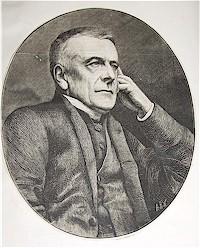
About Gerard Moultrie
Gerard Moultrie (1829 through 1885) was a distinguished clergyman and hymn writer of the Church of England. He was noted for his scholarly translations and his focus on niche liturgical subjects. Born on September 16, 1829, at Rugby Rectory, he was the son of the Reverend John Moultrie. His education followed a prestigious path through Rugby and Exeter College, Oxford, where he earned his M.A. in 1856.
His clerical career was diverse. He served as a master and chaplain at Shrewsbury School and held several curacies and chaplaincies, including service to the Dowager Marchioness of Londonderry. In 1869, he became the Vicar of Southleigh. Later, in 1873, he took on the role of Warden of St. James's College, Southleigh. Throughout these appointments, Moultrie established himself as a prolific author and a master of the "special occasion" hymn.
While many hymn writers of the 19th century focused on general themes of faith and salvation, Moultrie carved out a unique space. He wrote extensively for events and days that were often overlooked by his contemporaries. This included hymns for "Black Letter Saints' Days" (minor festivals in the church calendar), the laying of foundation stones, and even national thanksgivings for restored public health.
His work was deeply rooted in the High Church tradition. He frequently used the pseudonym "Desiderius Pastor" (abbreviated as "D. P.") when contributing to publications like the People’s Hymnal. His translations from Greek, Latin, and German helped preserve ancient liturgical sentiments for modern worshippers.
Moultrie’s literary output provided a rich resource for family and private prayer, as well as communal worship. His major works include:
-
The Primer (1864): A collection designed for family and private prayer, edited from post Reformation editions.
-
Hymns and Lyrics for the Seasons and Saints' Days of the Church (1867): This volume included his own work along with hymns by his sister, Mary Dunlop Moultrie.
-
Cantica Sanctorum (1880): A collection featuring over 100 hymns specifically for minor saints' days. Although he wrote the preface and contributed hymns, the book was primarily edited by Isabella Leefe.
Moultrie’s ability to capture a specific mood or occasion led to several of his hymns becoming standard processional or ceremonial pieces.
-
"We march, we march to victory": A famous processional hymn written in 1865 specifically for "present troubles."
-
"Forward, Christians, forward": Written for the Church of England Working Men’s Society, this leaflet was immensely popular, selling 40,000 copies in its first year.
-
"Sevenfold Spirit, Lord of life": Composed for the consecration of an American bishop in New York in 1867.
-
"Virgin-born the King of heaven": A specialized hymn written for midnight Christmas celebrations.
-
"I know that my Redeemer liveth": A funeral paraphrase of the Roman Office for the Dead, illustrating his skill in adapting formal liturgical texts.
Gerard Moultrie passed away on April 25, 1885. He is remembered as a writer who filled the gaps in the Anglican hymnal, providing beautiful and technically precise language for the most specific moments of the church year. His work moved beyond the generalities of worship to address the school house, the choir festival, and the "Black Letter" saints. By doing so, he enriched the liturgical life of his time with a sense of historical continuity and poetic grace. His hymns for marriage, burial, and national peace continue to serve as a testament to a life dedicated to the "faithful in family and private prayer."