About John Byrom
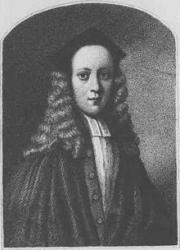
John Byrom was a man of diverse and remarkable talents—a Fellow of the Royal Society, a physician, and a pioneer in stenography—yet he is most enduringly remembered for his contributions to English hymnody. Born in Manchester in 1692 to a prosperous family of linen drapers, Byrom was educated at Trinity College, Cambridge, where he became a Fellow in 1714. After a brief period studying medicine in Montpellier, France, he returned to London and developed a revolutionary system of shorthand. His "Universal English Short-hand" was so highly regarded that he taught it to prominent figures of his day, including John and Charles Wesley, and was elected a Fellow of the Royal Society in 1724.
Despite his scientific and academic successes, Byrom wrote poetry primarily for his own recreation and for the benefit of his friends. He did not seek to publish his verses during his lifetime; they were only collected and released posthumously in 1773. His writing often reflected his spiritual leanings, which were influenced by the French mystics and his friend William Law. Though his total output of hymns used in modern worship is small, those that survived are considered masterpieces of the form, characterized by a refined literary style and a gentle, contemplative spirit.
Byrom’s most famous contribution is the Christmas hymn "Christians, Awake! Salute the Happy Morn." Written as a gift for his daughter, Dolly, on Christmas Eve in 1749, the text was originally titled "Christmas Day for Dolly." It remains one of the most beloved Christmas carols in the English language, particularly in Northern England. Another significant work is the deeply personal and rhythmic "My Spirit Longeth for Thee," which expresses a soul's yearning for divine comfort and presence with a simplicity that has made it a favorite in many devotional collections.
Upon succeeding to his family estates in Manchester, Byrom lived out his later years as a respected member of the local gentry until his death in 1763. He was a man who moved comfortably between the rigorous intellectual circles of the Royal Society and the fervent spiritual circles of the early Methodist movement. Today, his legacy resides not in the shorthand system he spent his life perfecting, but in the enduring lines of poetry that continue to call congregations to worship each Christmas morning.