About John Milton
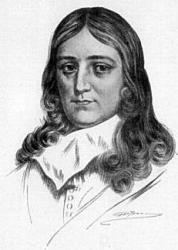
John Milton (1608–1674)
John Milton stands as one of the most significant figures in English literature, a poet and polemicist whose epic works, most notably Paradise Lost, redefined the English language. Born in London and educated at Christ’s College, Cambridge, Milton’s life was deeply entwined with the political and religious upheavals of the 17th century. A staunch defender of the Commonwealth and a civil servant under Oliver Cromwell, he spent his later years in total blindness, composing his greatest masterpieces through dictation. While his literary fame is vast, his specific impact on congregational hymnody is more subtle, consisting primarily of metrical paraphrases of the Psalms and excerpts from his larger poetic works.
Milton’s hymnological contributions began remarkably early; he composed his famous versions of Psalm 114 and Psalm 136 in 1623 at the age of fifteen. These early paraphrases reflect a youthful vigor and a firm grasp of the metrical requirements of the time. Throughout his life, he periodically returned to the Psalter, translating a group of nine psalms (80–88) in 1648 and a smaller selection in 1653. Unlike many of his contemporaries who favored the strict, sometimes clunky rhythms of the "Old Version" (Sternhold and Hopkins), Milton’s versions often displayed a more fluid and sophisticated poetic sense, even when adhering to common meter.
The most enduring of Milton’s hymns in modern use is "Let Us With a Gladsome Mind," a spirited paraphrase of Psalm 136. Celebrated for its rhythmic vitality and repetitive, joyful refrain ("For His mercies shall endure, ever faithful, ever sure"), the hymn remains a staple of Thanksgiving and general praise services across the globe. Another widely recognized piece is "The Lord Will Come and Not Be Slow," which is a cento (a poem compiled from verses of different origins) drawn from his paraphrases of Psalms 82, 85, and 86. This hymn is often used in Advent or for services focusing on social justice and the eventual triumph of divine truth.
Beyond his direct psalm paraphrases, Milton’s masterpiece on the Incarnation, "On the Morning of Christ's Nativity," has provided the church with several beautiful centos for Christmas. Verses beginning with "This is the month, and this the happy morn" or "No war or battle's sound" allow congregations to engage with Milton’s grand vision of the peace brought by the birth of Christ. Though his total output specifically intended for singing was small compared to giants like Isaac Watts, Milton’s work ensures that the "majesty of the English tongue" continues to echo from the choir loft as much as from the library shelf.