About John Page Hopps
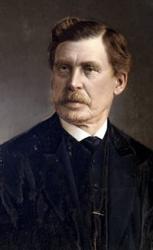
John Page Hopps (1834–1911)
John Page Hopps was a prominent English Unitarian minister, editor, and social reformer who spent his career at the intersection of radical theology and populist outreach. Born in London and educated at the General Baptist College in Leicester, Hopps’ early ministry saw him serving as a colleague to the famed George Dawson in Birmingham—a leader of the "Civic Gospel" movement. This background heavily influenced Hopps' conviction that religion should be a force for social progress and intellectual honesty. Over the next two decades, he led influential congregations in Sheffield, Dukinfield, and Glasgow before returning to Leicester in 1876, where his afternoon and evening "Special Services" for the working classes became a local phenomenon.
Hopps was a prolific compiler of hymnbooks, producing at least eight distinct collections for congregations, Sunday schools, and mission services. His work as an editor was driven by a desire to provide a "hymnody of faith and progress" that moved away from rigid dogma and toward a more inclusive, ethical spirituality. In 1863, he founded The Truthseeker, a monthly periodical that became a platform for his controversial and progressive views. He was particularly concerned with providing high-quality worship materials for children and young people, as evidenced by his publications like The Children's Hymn Book (1879) and The Young People’s Book of Hymns (1881).
As a hymn-writer, Hopps is best remembered for his simple, direct, and tender verses, many of which were written specifically for children. His most enduring contribution is the prayer for guidance, "Father, Lead Me Day by Day." This hymn, noted for its rhythmic clarity and humble tone, became a staple of Sunday school education across various denominations, from Unitarian to Anglican. His verses often explored themes of divine presence in everyday life and the redemptive power of challenges, as seen in "We Praise Thee Oft for Hours of Bliss," which reflects on the "blessings of sorrow."
Throughout his life, Hopps remained a controversial and energetic figure, unafraid to challenge theological orthodoxy in the name of truth-seeking. He believed that the church should be a "home for the soul" that welcomed scientific discovery and social reform. When he passed away in 1911, he left behind a legacy as a "people's preacher" whose hymns continues to provide a gentle and accessible entrance into the life of faith for generations of children.