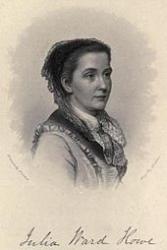
About Julia Ward Howe
Julia Ward Howe was a towering figure in 19th-century American intellectual life, distinguished as a poet, social reformer, and prominent abolitionist. Born into a wealthy New York City family in 1819, she moved to Boston following her marriage to the philanthropist Samuel Gridley Howe in 1843. There, she became a central force in the transcendentalist and reformist circles, championing women's suffrage, pacifism, and the abolition of slavery. While she authored several volumes of poetry, including Passion Flowers (1854) and Later Lyrics (1866), her legacy is indelibly linked to a single night of inspiration that produced one of the most powerful anthems in American history.
In November 1861, during the early months of the American Civil War, Howe traveled to Washington, D.C., with her husband and their pastor, the Reverend James Freeman Clarke. While reviewing Union troops, she heard the soldiers singing the popular but gritty camp song "John Brown’s Body." Dr. Clarke challenged her to write "more uplifting" words to the catchy "Glory, Hallelujah" melody. According to her own accounts, the verses began to form in her mind in the early hours of the following morning at the Willard Hotel. She famously wrote the poem in the "gray of the morning twilight" with a stub of a pen, making almost no revisions.
The poem was published in The Atlantic Monthly in February 1862, for which Howe received a modest fee of five dollars. Although she wrote the text as a patriotic poem rather than a liturgical hymn, its apocalyptic imagery, drawing heavily from the Book of Revelation and the "grapes of wrath", resonated deeply with the religious fervor of the Union cause. The poem gained national fame after it was championed by Chaplain C. C. McCabe (later a Methodist Bishop), who sang it for Union troops and fellow prisoners of war in Libby Prison.
Beyond the "Battle Hymn," Howe’s influence extended into significant social advocacy. In 1870, she issued her "Mother's Day Proclamation," which laid the spiritual and political groundwork for the modern holiday as a day dedicated to peace and the global disarmament of nations. She remained a prolific writer until her death, publishing works like From Sunset Ridge (1896) that reflected her maturity and continued activism.
Julia Ward Howe died in 1910 in Rhode Island, celebrated as the "Grand Old Lady of American Letters." Today, the "Battle Hymn of the Republic" remains a staple in American hymnals, bridging the gap between a national anthem and a sacred song. It serves as a lasting testament to her belief that the "Truth is marching on" and continues to be used as a rallying cry for justice and moral perseverance.