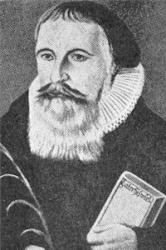
About Martin Rinkart
Martin Rinckart was a German clergyman and poet whose life serves as a profound testament to faith and resilience during one of Europe’s darkest eras. Born in 1886 in Eilenburg, Saxony, Rinckart was the son of a cooper. He rose from humble beginnings to become a foundation scholar at St. Thomas's School in Leipzig and eventually the Archidiaconus of his hometown. However, his legacy is defined less by his ecclesiastical rank and more by his heroic service during the Thirty Years' War (1618–1648), a conflict that brought unimaginable suffering to the German states.
The Pastor of the Plague
Eilenburg, a walled city, became a crowded sanctuary for thousands of fugitives fleeing the war. This overcrowding led to catastrophic famine and a devastating outbreak of the plague in 1637. During this period, Rinckart was often the only clergyman left in the city. He reportedly performed burial services for over 4,000 people, sometimes reading the service for 50 individuals in a single day. Among the dead was his own wife, Christina, in May 1637. Despite the personal tragedy and the constant threat of Swedish invasion, from which he twice saved the city through bold negotiation, Rinckart remained a pillar of strength, exhausting his personal resources to feed the starving.
"Nun danket alle Gott" (Now Thank We All Our God)
Amidst this backdrop of death and destruction, Rinckart authored what is now known as the "German Te Deum." While legend often claims he wrote it to celebrate the Peace of Westphalia in 1648, evidence suggests it was written around 1636 for his collection Jesu Hertz-Büchlein. The hymn is a masterful paraphrase of Ecclesiasticus (Sirach) 50:22–24, and its third stanza is a version of the Gloria Patri.
The hymn’s enduring power lies in its defiant gratitude. It was not a song written in a time of plenty, but a prayer of "childlike devotion" forged in a time of profound loss. It has since become a staple of national thanksgivings, used at major events such as the completion of the Cologne Cathedral and the laying of the foundation stone of the German Reichstag.
Literary and Musical Legacy
Rinckart was a prolific writer, though many of his works have been lost to history. His surviving contributions include:
-
The "Reformation Comedies": A cycle of seven dramas written for the 1617 centenary of the Reformation.
-
"So fahr ich hin mit Freuden": A tender funeral hymn written in memory of his wife, Christina, expressing a "soul-rejoicing farewell" from the "valley of misery."
-
Hymn Tunes: While the famous tune for "Now Thank We All Our God" is often attributed to Johann Crüger, it is widely believed that Crüger may have adapted it from a motet or melody originally composed by Rinckart himself.
Rinckart died in 1649, just a year after the peace he had long prayed for finally arrived. He was a "worn-out and prematurely aged man," having spent his life's blood for his congregation. Today, he is remembered not only as a poet but as a "Teutsche Jobs-Schwester" (a German brother to Job), whose firm confidence in God's mercy allowed him to sing songs of thanks while standing in the midst of ruins.