About N. B. Herrell
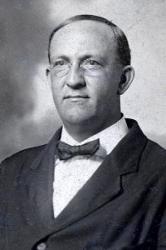
Noah Benjamin Herrell (1877–1953) was a foundational minister, administrator, and songwriter within the Church of the Nazarene during its crucial formative decades. Born in Miami, Indiana, Herrell’s life shifted dramatically in 1901 when he experienced conversion and sanctification under the revival preaching of Lillian Belle Vanderbur. Two years later, he married the young evangelist, beginning a lifelong partnership in gospel ministry that would produce a large family and leave an indelible mark on the holiness movement across the United States.
Herrell’s primary legacy in the American church is that of an energetic institutional builder and administrative visionary. Serving as a District Superintendent across multiple regions, including Pittsburgh, Northern California, Idaho-Oregon, Ohio, and Kansas City, he was instrumental in establishing the physical and educational infrastructure of his denomination. Notably, he brought the Illinois Holiness University into the Nazarene fold, transforming it into Olivet Nazarene College, and later helped build Northwest Nazarene College and the Good Samaritan Hospital in the West. He was also a pioneering voice in the theology of church administration, spending over thirty-five years preaching and practicing the principles of Christian stewardship, which he later compiled into books such as The Way of Christian Prosperity and Christ at the Controls.
Despite his extensive executive and pastoral workload—which included pastoring churches in Kansas, Indiana, and Virginia—Herrell maintained a deep, creative connection to congregational music. Remarkably, he could not read or write music. His songwriting was entirely a matter of spiritual inspiration; he frequently experienced moments where both the lyrical verse and the vocal melody came to him simultaneously as a unified whole. This intuitive, non-academic approach was characteristic of many early 20th-century holiness preachers, who relied on memorably simple, singable cadences to capture the emotional and spiritual fervor of camp meetings and revival services.
Forced into retirement by a heart ailment while pastoring in Arlington, Virginia, Herrell eventually relocated to Pasadena, California, where he passed away in 1953. He remains a prime example of the "pioneer superintendent" era of American evangelicalism, a leader who could balance the practical, legal, and financial complexities of founding colleges and campgrounds with the spontaneous, artistic expression of personal faith through song.