About Oliver Wendell Holmes
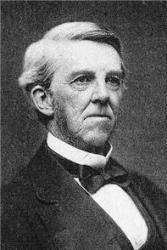
Oliver Wendell Holmes (1809–1894) was a towering figure in 19th-century American letters, medicine, and intellectual culture who also made a profound and lasting contribution to sacred song. Born in Cambridge, Massachusetts, as the son of a prominent Congregational minister, Holmes graduated from Harvard University in the famous class of 1829. He pursued a career in medicine, training in Boston and Paris, and in 1847 was appointed the Parkman Professor of Anatomy and Physiology at Harvard Medical School, a prestigious academic chair he occupied for thirty-five years. Beyond his pioneering medical insights, Holmes achieved global celebrity as one of the "Fireside Poets" and as a master essayist, captured most brilliantly in his celebrated literary series The Autocrat of the Breakfast-Table and its sequels.
As a member of the Unitarian body, Holmes’s personal faith was marked by a deep skepticism toward rigid, traditional creeds and a profound trust in a benevolent, loving Creator. Although he considered himself an occasional writer of verse rather than a dedicated hymnwriter, several of his poems possessed such deep spiritual resonance and lyrical beauty that they readily transitioned into congregational song. His religious poetry was noted by scholars like John Julian for its exceptional merit, successfully blending intellectual depth with rich, emotional warmth. Many of his texts first reached the public embedded within his prose essays, such as "Lord of all being, throned afar," a magnificent exploration of divine omnipresence, and "O Love divine that stoop'st to share," a hymn of deep personal trust, both of which appeared in his 1859 volume The Professor at the Breakfast-Table.
Holmes’s hymns also frequently emerged from his deep engagement with current events and civic life. At the outbreak of the American Civil War in 1861, he penned the stirring patriotic texts "O Lord of hosts, Almighty King" and "Freedom, our Queen" (beginning "Land where the banners wave last in the sun"), providing a faithful voice for a nation locked in a struggle for its preservation. Later in life, he wrote "Our Father, while our hearts unlearn / The creeds that wrong Thy name" for the 1893 anniversary of the Boston Young Men's Christian Union, an explicit poetic critique of harsh theological dogmas in favor of a religion based on the fruits of the Spirit. He also maintained a lifelong devotion to his university alma mater, composing the reunion hymn "Thou gracious God, Whose mercy lends" for the 40th anniversary of his Harvard class.
Through these varied contributions, Holmes became one of the few figures to successfully bridge the worlds of secular literature, scientific academia, and liturgical music. His hymns crossed the Atlantic to find extensive use in Great Britain, finding a home in influential non-conformist and ecumenical collections like James Martineau's Hymns of Praise and Prayer. Honored late in life with a Doctor of Civil Law degree from the University of Oxford, Holmes passed away in 1894, leaving behind a dual legacy: a scientific mind that helped modernize American medicine, and a poetic spirit that left the church some of its most enduring, sublime literary statements on the majesty and mercy of God.