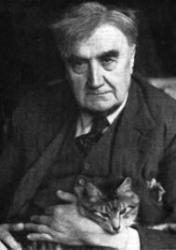
About Ralph Vaughan Williams
Ralph Vaughan Williams (1872–1958) stands as the towering colossus of 20th-century English music. A master symphonist, conductor, and ethnomusicologist, he fundamentally rescued British music from heavy Germanic influences by anchoring it back into its own soil.
Remarkably, while Vaughan Williams was a lifelong "cheerful agnostic" (as described by his second wife, Ursula), his contribution to Christian hymnology is arguably greater than that of any other single figure in the modern era. As a brilliant music editor, he cleansed congregational singing of what he considered cheap, overly sentimental Victorian melodies, replacing them with rugged, beautiful historic folk tunes and breathtaking original compositions that elevated the artistic and spiritual standard of corporate worship worldwide.
The English Folk Song Revival: Sifting the Soil
Born on October 12, 1872, in the idyllic village of Down Ampney, Gloucestershire, Vaughan Williams enjoyed a stellar academic pedigree, studying at the Royal College of Music and Trinity College, Cambridge, with additional training under Max Bruch in Berlin and Maurice Ravel in Paris.
Despite this elite classical framing, his artistic epiphany occurred in 1903 when he heard a farm laborer sing a traditional ballad. Mesmerized by its organic, modal beauty, Vaughan Williams spent years traversing the English countryside with a notebook, meticulously transcribing and preserving more than 800 authentic folk songs from elderly citizens before they were lost to history.
He realized these natural, sweeping melodies possessed an inherent dignity, a rhythmic flexibility, and a timeless melodic contour perfectly suited for the human voice. When he was approached to edit church music, he used this massive archive as his primary musical source.
Redefining Corporate Worship: The English Hymnal (1906)
In 1904, a committee led by the high-church Anglican clergyman Percy Dearmer asked Vaughan Williams to serve as the musical editor for a radical new project: The English Hymnal.
At the time, British churches were dominated by highly dramatic, sugary Victorian tunes that Vaughan Williams famously dismissed as "shoddy" and "effeminate." He accepted the editing post under one condition: he would have absolute veto power over the music. He spent two exhausting years standardizing tempos, selecting texts, and marrying words to melodies.
His editorial strategy forever altered global hymnody through three brilliant methods:
1. Adapting Folk Music into Sacred Tunes
Vaughan Williams took the secular English folk songs he had collected and carefully adapted them into congregational hymn tunes. To obscure their secular origins, he named the newly minted tunes after the geographical locations where he discovered them.
-
KINGSFOLD: A traditional English melody he collected, which he matched to Horatius Bonar's text, "I Heard the Voice of Jesus Say."
-
FOREST GREEN: A beautiful traditional winter tune he transcribed in Surrey, which he skillfully adapted for the classic Christmas carol, "O Little Town of Bethlehem."
2. Composing Original Masterpieces
When a historic text lacked a suitable melody, Vaughan Williams composed his own. He contributed some of the greatest original congregational tunes ever written:
-
SINE NOMINE ("Without Name"): Composed specifically for William Walsham How's magnificent text, "For All the Saints." Vaughan Williams replaced a dreary Victorian tune with a majestic, syncopated, and triumphant marching melody that became an international standard.
-
DOWN AMPNEY: Named after his birthplace, he composed this profoundly tender, breathing melody for the 14th-century Italian mystic text, "Come Down, O Love Divine."
3. Restoring Historic Treasures
He dug into the archives of the Protestant Reformation, resurrecting forgotten, rhythmically complex melodies by Renaissance master Thomas Tallis (including the famous Third Mode Melody, which he later expanded into his orchestral masterwork, Fantasia on a Theme by Thomas Tallis) and classic 16th-century Genevan psalm tunes.
The Later Editorial Trio
The monumental success of The English Hymnal established Vaughan Williams as Britain's chief authority on liturgical music. In the decades that followed, he partnered with musician Martin Shaw and Percy Dearmer to compile two more foundational collections that expanded the sonic imagination of the church:
-
Songs of Praise (1925, 1931): An ecumenical, forward-thinking hymnal that prioritized social justice and natural themes. For the 1931 edition, Vaughan Williams notably commissioned a young children's author named Eleanor Farjeon to write a fresh morning hymn to fit a traditional Gaelic melody. The result was "Morning Has Broken" (tune: BUNESSAN).
-
The Oxford Book of Carols (1928): The definitive anthology that single-handedly rescued the traditional, earthy folk carol format from obscurity, making caroling a permanent centerpiece of modern Christmas tradition.
Death and Eternal Rest
Vaughan Williams continued composing monumental symphonies and deep sacred choral-orchestral works (Dona Nobis Pacem, Hodie) well into his eighties. He passed away peacefully on August 26, 1958, in London. Given his status as a national treasure, he was granted the supreme honor of burial in the North Choir Aisle of Westminster Abbey, resting alongside iconic British figures like Isaac Newton and Charles Darwin.
His enduring monument is not merely found in grand concert halls, but in tens of thousands of local sanctuaries every Sunday morning. By honoring the raw, honest beauty of folk song, an agnostic composer gave the global church a rich, enduring vocabulary with which to sing praises to the divine.