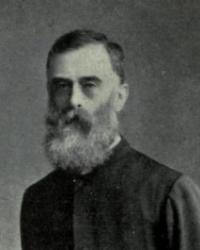
About Thomas Benson Pollock
Thomas Benson Pollock (1836–1896) was an Irish-born Anglican priest, poet, and urban missionary who became the undisputed master of the metrical litany in the Victorian era. Operating deep within the Anglo-Catholic ritualist movement, Pollock turned down comfortable ecclesiastical placements to spend nearly three decades alongside his brother ministering to the impoverished slums of Birmingham. His highly specialized, deeply rhythmic litanies successfully transformed an ancient, rigid style of responsive church prayer into beautiful, congregational singing.
The Academic Poet and Urban Missionary
Born in 1836, Thomas Benson Pollock was educated at Trinity College, Dublin. He proved to be an exceptional literary talent early on, winning the prestigious Vice-Chancellor's Prize for English Verse in 1855. He graduated with his Bachelor of Arts in 1859 and completed his Master of Arts in 1863.
After taking Holy Orders in 1861, Pollock served brief curacies in Staffordshire and London before moving to Birmingham to join his brother, the Reverend James S. Pollock, at St. Alban the Martyr.
                 ┌──────────────────────────────────────┐
                 │     THE ST. ALBAN'S SLUM MINISTRY    │
                 └──────────────────┬──────────────────┘
                                    │
         ┌──────────────────────────┴──────────────────────────┐
         ▼                                                     ▼
  SACRAMENTAL WORSHIP                                  SOCIAL JUSTICE
Rich ritualism, vestments, and                      Building schools, providing free food,
rhythmic singing to bring beauty                    and caring for cholera and typhoid victims
to an otherwise bleak environment.                  in the industrial heart of Birmingham.
St. Alban's was situated in one of the poorest, most neglected industrial districts of Birmingham. The Pollock brothers became legendary figures—affectionately chronicled in the 1911 biographical history Father Pollock and His Brother—for their radical self-sacrifice. They brought vibrant, beautiful sacramental worship to the urban poor, establishing schools, organizing relief for the destitute, and living in strict personal poverty to fund their parish projects.
Master of the Metrical Litany
While Pollock wrote several standard hymns, his enduring legacy to the global church lies in his total mastery of the metrical litany.
Traditional litanies are long, spoken responsive prayers led by a priest with the congregation chanting a fixed refrain (e.g., "Good Lord, deliver us"). Pollock realized that these could be written in poetic, rhyming verses using a specialized 7.7.7.6 meter. This allowed the entire congregation to sing the theological verses together, punctuated by a short, memorable musical response at the end of every stanza.
In 1870, he published his landmark collection:
Metrical Litanies for Special Services and General Use (Mowbray)
These compositions provided high-church parishes with structurally perfect, musically engaging devotionals for deep seasons of penitence like Lent and Holy Week. His works were widely distributed through The Gospeller, a popular monthly Christian periodical, and quickly became standard additions to massive national hymnals like the 1889 Supplement to Hymns Ancient & Modern.
Liturgical Masterpieces and Hymns
Pollock’s litanies are celebrated for their theological emotional depth, structural economy, and intense rhythmic focus.
1. Jesu, in Thy dying woes (The Litany of the Seven Last Words)
This is widely regarded as Pollock's absolute masterpiece. Written for The Gospeller and famously expanded into seven distinct parts in Thring’s 1882 Collection, this litany walks congregations sequentially through the Seven Last Words of Christ on the Cross. Each section features three poetic stanzas meditating on Christ's physical and spiritual agony, followed by a communal plea for mercy. It remains the gold standard for Good Friday three-hour services across the globe.
2. Holy Saviour, hear me; on Thy Name I call (Litany of the Contrite)
A deeply moving, personal prayer of repentance. From this long metrical litany, editors later extracted one of the most beloved children's hymns of the early 20th century:
Faithful Shepherd, feed me
In the pastures green;
With Thy guiding staff direct me
By the running stream.
3. My Lord, my Master, at Thy feet adoring
In 1887, Pollock demonstrated his skill as a translator by tackling a historic French Passion text, "Est-ce vous que je vois, ô mon Maître adorable!", written by the famous 18th-century missionary priest Jacques Bridaine. Pollock's English translation beautifully preserved the vivid, dramatic emotionalism of the French original, offering a haunting meditation on Christ's suffering for Passiontide.
| Litany / Hymn Title | Liturgical Theme | Core Focus |
| God of mercy, loving all | Quinquagesima | Preparing the heart for the self-denial of Lent |
| Great Creator, Lord of all | Holy Trinity | High dogmatic adoration of the Triune Godhead |
| We are soldiers of Christ | Discipleship / Warfare | A brisk, spirited processional on Christian endurance |
| We have not known Thee as we ought | Seeking God | A corporate confession of spiritual lukewarmness |
| Weep not for Him Who onward bears | Passiontide | Shifting focus from pitying Christ to repenting of sin |