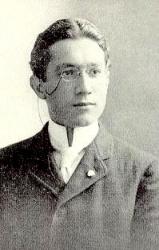
About Thomas E. Herbranson
Thomas Edmond Herbranson (1933–2009) was a 20th-century American Lutheran clergyman, missionary, and hymn writer. A lifelong musician who shared his faith through song, Herbranson served a variety of diverse ministries, ranging from Midwest college campuses to bilingual mission churches for the poor in Mexico City. Though he spent the latter half of his career in corporate public relations, his enduring contribution to global hymnody is a profoundly intimate, scripturally rich baptismal hymn that became an ecumenical staple across North America.
Academic Roots and Pastoral Ministry
Thomas E. Herbranson was born on December 3, 1933, in Bagley, Minnesota. He grew up immersed in the rich choral traditions of Midwestern Scandinavian Lutheranism. He attended St. Olaf College in Northfield, Minnesota, graduating with his Bachelor of Arts in 1955. During his time there, he sang with the world-renowned St. Olaf College Choir, cementing a lifelong passion for church music.
Discerning a call to the ordained ministry, he enrolled at Luther Theological Seminary in St. Paul, Minnesota, earning a Bachelor of Divinity in 1960 and later a Master of Theology in 1970.
Following his ordination in 1861 into the American Lutheran Church (later part of the ELCA), Herbranson’s early ministry was characterized by diverse, community-focused assignments:
-
Campus Ministry (1960–1962): Served as a campus pastor at Winona State College, Minnesota, navigating the rapidly shifting cultural landscape facing college students in the early 1960s.
-
Home Missions (1963–1867): Planted and pastored a home mission church in White Bear Lake, Minnesota, establishing a spiritual foundation for a rapidly growing suburban community.
-
International Mission Work (1967–1969): Relocated his family to Mexico City, where he pastored a bilingual church for the poor, alongside ministry outreach to impoverished communities in San Fernando, Guadalajara, and Cuernavaca.
Corporate Stewardship and Continued Choral Witness
In 1971, Herbranson pivoted his professional focus, joining the public relations and communications department of the Lutheran Brotherhood Insurance Company (now Thrivent Financial) in Minneapolis. This allowed him to merge his pastoral sensibilities with executive stewardship, helping direct the fraternal benefit society's philanthropic outreach and community investment programs for decades.
Even while working in the corporate sphere, Herbranson remained a vital fixture in the Minnesota choral community. For many years, he sang with the Augsburg Centennial Singers, a specialized male chorus dedicated to traveling and, as they put it, "passing on the faith through song."
The Masterpiece: "This Is the Spirit's Entry Now"
While Herbranson was not a prolific writer of hymn texts, he secured a permanent place in modern liturgy with a single, magnificent baptismal anthem: "This Is the Spirit's Entry Now."
The hymn was born out of an intensely personal, pastoral moment while Herbranson was serving the congregation in White Bear Lake in the mid-1960s. Anticipating the birth and upcoming baptism of his first child, Herbranson looked for a text that captured the full, dramatic weight of sacramental baptism. Finding standard options lacking, he penned his own text.
                      ┌───────────────────────────────────────┐
                      │    HERBRANSON'S ECUMENICAL METEOR     │
                      └───────────────────┬───────────────────┘
                                          │
         ┌────────────────────────────────┼────────────────────────────────┐
         ▼                                ▼                                ▼
 1972: LUTHERAN DEBUT             1978: CONTINENTAL ADOPTION       1989: ECUMENICAL EXPANSE
Published in 'Contemporary       Adopted into the standard         Migrated beyond Lutheran pews
Worship 4' as a premier          'Lutheran Book of Worship'       into the United Methodist Hymnal
sacramental text.                across North America.             and Canadian 'Voices United'.
Lyrical and Theological Architecture
The hymn is structured around a profound theological paradox: that baptism is simultaneously a regular water ritual, a mystical washing, and a spiritual death and resurrection. Drawing heavily on Romans 6:3–9 and Titus 3:5–7, Herbranson cleanly outlines the trajectory of grace:
-
Stanza 1 (The Threshold): Introduces the water of baptism not as a simple naming ceremony, but as the literal doorway of the Holy Spirit into the human soul.
-
Stanza 2 (The Mystical Grave): Connects the baptismal font directly to Christ's burial, stating that the believer is drowned to their old self.
-
Stanza 3 (The Resurrection): Proclaims that the baptized individual rises from the water clothed in the seamless, radiant robe of Christ's righteousness.
-
Stanza 4 (The Eternal Horizon): Frames the sacrament as a permanent stamp that secures the believer's final resurrection at the end of time.
Hymn Excerpt: The Sacramental Mystery
This is the Spirit's entry now,
The water and the word,
The sign of Jesus on the brow,
The shedding of his blood.
We die with Christ, and we are dead
To sin and all its ways;
With him we bury shame and dread
And rise to share his grace.
Global Impact and Tunes
The text made its formal debut in Contemporary Worship 4 (1972), a supplemental volume explicitly curated by the Inter-Lutheran Commission on Worship to revitalize baptismal and communion liturgies. It was an instant classic. It was adopted sequentially into the landmark Lutheran Book of Worship (LBW, 1978), the Lutheran Service Book (LSB, 2006), and Evangelical Lutheran Worship (ELW, 2006).
Recognizing its raw scriptural clarity, the text quickly broke denomination lines. It was adopted into the United Methodist Hymnal (1989) and the United Church of Canada’s Voices United (1996).
While Herbranson originally intended the text to be paired with the tune PERRY (composed by Leo Sowerby), editors have successfully paired it with other iconic, lilting meters:
| Primary Associated Tune | Musical Origin | Congregational Atmosphere |
| LAND OF REST | Traditional North American Folk Melody | Contemplative, rootsy, and deeply resonant of the early American frontier church. |
| AZMON | Carl G. Gläser (Arr. Lowell Mason) | Triumphant, standard Common Meter (CM) that allows for robust, confident ensemble singing. |
Rev. Thomas E. Herbranson passed away on November 13, 2009, in Edina, Minnesota, at the age of 75. Having spent his life moving between mission fields and corporate boards, his voice continues to echo over baptismal fonts worldwide every time a new child is brought to the water.