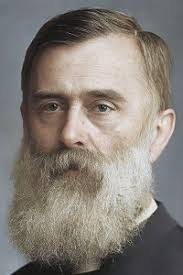
About Thomas Pollock
Thomas Benson Pollock (1836–1896) was an English-born Anglican clergyman, medical student, and mission priest who became the undisputed master of the metrical litany during the late-Victorian Catholic Revival. Along with his brother, James, he spent three decades ministering to the absolute poorest, most marginalized industrial communities in Birmingham. While his daily life was consumed by sanitation reform, tending to the sick, and enduring intense anti-ritualist persecution, his structured, rhythmic, and deeply searching liturgical verses provided the Church of England with an entirely refreshed vehicle for corporate repentance and prayer.
The Isle of Man to the Birmingham Slums
Thomas Benson Pollock was born on May 28, 1836, at Strathallan House on the Isle of Man, the son of a prominent British army officer who had fought in the Napoleonic Wars. He was educated at Trinity College, Dublin, where he excelled academically, graduating with his Bachelor of Arts in 1859 and a Master of Arts in 1863. Demonstrating a keen poetic sensibility early in life, he was awarded the prestigious Vice-Chancellor’s Prize for English Verse in 1855.
Initially, Pollock’s ambitions lay in the field of medicine. He underwent significant medical training, a background that would uniquely shape his future pastoral ministry. However, he ultimately discerned a calling to Holy Orders and was ordained a deacon in 1861 and a priest in 1862. After serving brief curacies in Staffordshire and London, his life path was permanently altered by a call from his older brother, James Samuel Pollock.
James had established a mission chapel in a sprawling, unchurched, and deeply impoverished slum district of Bordesley, Birmingham. Thomas went to join his brother for what was intended to be a temporary, two-week visit; that visit ultimately stretched into an extraordinary, unbroken thirty-year partnership. Together, the Pollock brothers transformed the mission into the historic parish of St. Alban the Martyr, Birmingham.
                 ┌──────────────────────────────────────┐
                 │      THE POLLOCK BROTHERS' MISSION   │
                 └──────────────────┬──────────────────┘
                                    │
         ┌──────────────────────────┴──────────────────────────┐
         ▼                                                     ▼
THE FRONTLINE OF URBAN POVERTY                        THE FIRES OF THE OXFORD MOVEMENT
Thomas combined medicine and theology to manage        As high-church Anglo-Catholics, they faced
public health crises, sewers, and disease outbreaks.   bitter legal battles and anti-ritualist riots.
Life at St. Alban’s was physically demanding and spiritually intense. The brothers were staunch adherents of the Oxford Movement, which sought to reclaim the pre-Reformation, high-church Catholic heritage of the Anglican liturgy. This stance provoked bitter hostility from local low-church and secular factions, occasionally resulting in violent anti-ritualist street riots outside their chapel.
Undeterred, the Pollocks won over the community through radical, practical self-sacrifice. Utilizing his medical training, Thomas acted as a frontline physician for the neighborhood, personally treating the destitute, managing sanitation overhauls, and fearlessly combatting localized epidemics. When James passed away in 1895, Thomas briefly succeeded him as the second Vicar of St. Alban’s, before dying himself just one year later.
The Master of the Metrical Litany
While Thomas Pollock authored standard standalone hymns, his enduring monument in hymnology is his revolutionary refinement of the metrical litany. A litany is a ancient form of responsive prayer consisting of a series of petitions sung by a leader, each followed by a fixed congregational response (such as "Good Lord, deliver us" or "We beseech Thee to hear us").
Before Pollock, these were almost exclusively rendered in heavy, unrhymed liturgical prose. Pollock realized that if these massive streams of prayer were cast into tight, beautiful poetic meters, they would become infinitely more accessible to children, uneducated laborers, and standard working-class congregations.
He wrote with a rhythmic fluidness that became a literal compulsion; his brother James often joked that Thomas wandered the vicarage constantly humming and building lines, warning him of the dangers of rhyming oneself into insanity. Pollock modestly dismissed his own genius, claiming: "I am only a rhymer, and I do not profess to be more than a mechanical builder up of lines." The editorial world thought otherwise. John Julian, the premier authority of the era, praised Pollock as "a most successful writer... who has greatly enriched modern hymnbooks." Pollock published his structural pieces in two foundational volumes: Metrical Litanies for Special Services and General Use (1870) and the Litany Appendix (1871). When the landmark 1875 edition of Hymns Ancient & Modern was published, Pollock's compositions single-handedly made up over half of the entire litany section.
Landmark Masterpieces and Core Texts
Pollock’s works are celebrated for their stark honesty, balancing raw human failure against the unshakeable assurance of divine grace.
1. Jesu, with Thy Church Abide
Originally written as a specialized litany "Of the Church," parts of this text were explicitly prepared for the Society for the Propagation of the Gospel's Day of Intercession in 1871. It remains a standard Anglo-Catholic processional prayer, begging Christ to protect, purify, and guide the church through corporate scandal, internal division, and external persecution.
Hymn Excerpt: The Cry for Ecclesial Preservation
Jesu, with Thy Church abide,
Be her Savior, Lord, and Guide,
While on earth her steps are tried:
We beseech Thee, hear us.
2. We Have Not Known Thee as We Ought
First published in October 1875 in The Gospeller—a monthly parochial magazine edited and distributed by the Pollock brothers to reach working-class homes—this text was originally written in the deeply personal, first-person singular ("I have not loved Thee as I ought"). Shifted into the corporate plural for the 1889 Supplement to Hymns Ancient & Modern, it stands as a brilliant, searing confessional piece. The poem moves systematically through five distinct interior shortfalls: a failure to properly know, fear, love, serve, and hope in God, countering each confession with a desperate plea for transforming grace.
Hymn Excerpt: The Confession of Trifles
We have not known Thee as we ought,
Nor learned Thy wisdom, grace, and power;
The things of earth have filled our thought,
And trifles of the passing hour.
Lord, give us light Thy truth to see,
And make us wise in knowing Thee.
Summary of Major Devotional Works
| Hymn / Litany First Line | Original Source / Year | Liturgical Focus & Character |
| Jesu, with Thy Church Abide | Litany Appendix (1871) | Ecclesial guidance, structural protection, and mission unity. |
| We Have Not Known Thee as We Ought | The Gospeller (1875) | Interior repentance, self-examination, and a plea for spiritual light. |
| Faithful Shepherd, feed me | Standalone Youth Hymn | A sweet, highly protective baptismal and confirmation prayer for children. |
| We are soldiers of Christ, Who is mighty to save | The Gospeller (1875) | A driving, energetic, and triumphant ballad mapping out the Christian warfare. |
| Jesu, in Thy dying woes | Metrical Litanies (1870) | A classic, profound multi-part meditation on the Seven Last Words from the Cross. |
Thomas Benson Pollock passed away in the industrial district of Bordesley, Birmingham, on December 15, 1896, at sixty years of age, universally mourned by the thousands of poor citizens he had housed, healed, and comforted. He was buried in the heart of the city he refused to abandon. Though he viewed himself as a mere mechanic of meter, his structured lines succeeded in giving the modern church a permanent, beautifully singing language for its deepest moments of confession and corporate prayer.