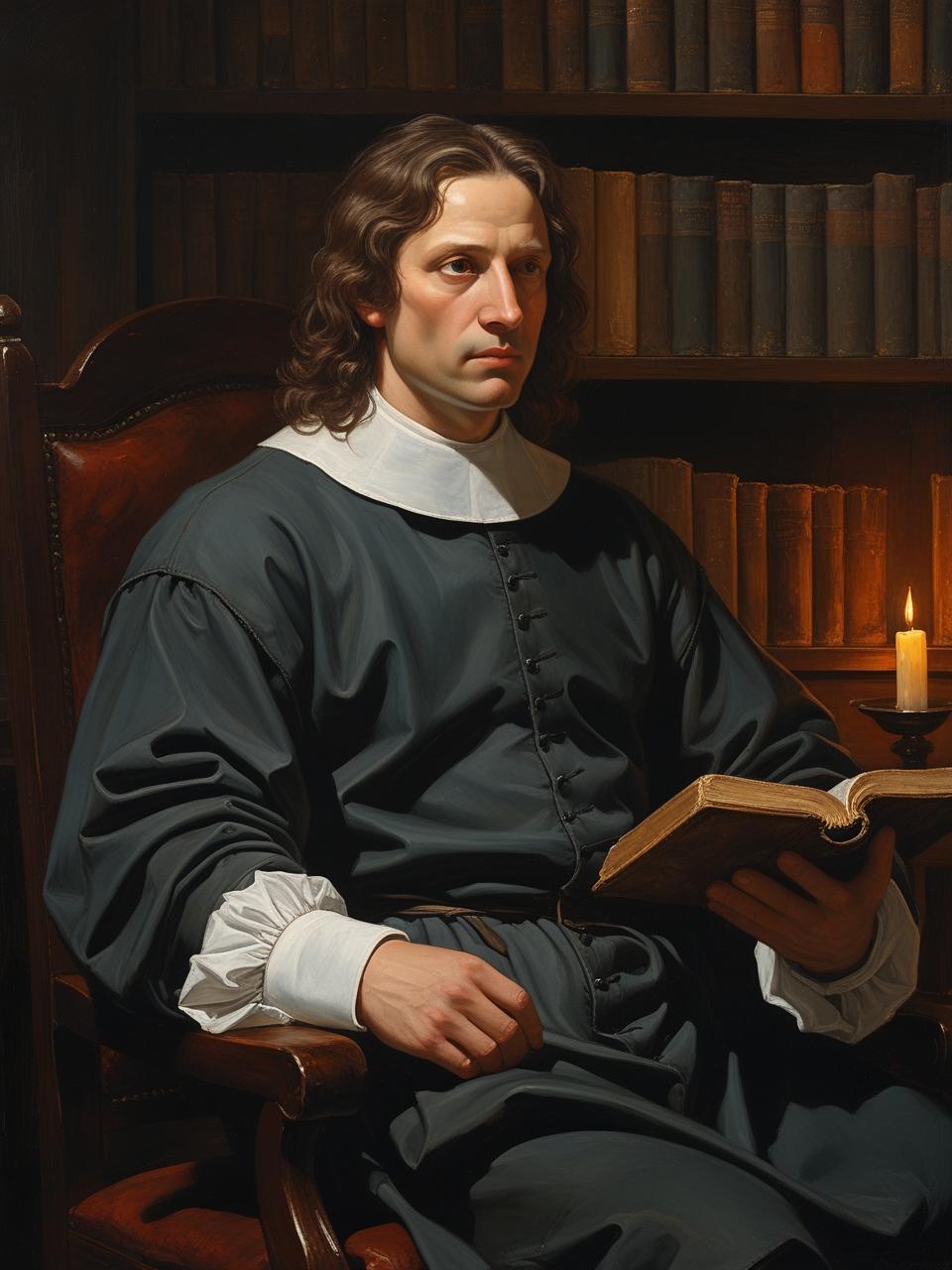
About Thomas Shepherd
Thomas Shepherd (1665–1739) was an early 18th-century English clergyman, nonconformist minister, and sacred poet who played a foundational role in the transitional era of English hymnody. The son of an Anglican vicar turned Dissenter, Shepherd initially followed his father into the Church of England before executing his own dramatic secession to become an Independent pastor in Nottingham and Essex. While his daily ministry was spent establishing nonconformist chapels from the ground up, his enduring monument in church history is a collection of deeply intense, emotionally raw devotional poems that gave the early dissenting movement a passionate vocabulary for personal repentance and spiritual longing.
The Path of Nonconformity: From Rectory to Barn
Thomas Shepherd was born in 1665, the son of William Shepherd, who was at the time the Anglican Vicar of Tilbrook in Bedfordshire. His father eventually chose to leave the established church, taking up nonconformist pulpits in Oundle and Kettering. Despite his father's departure from the Church of England, the young Thomas initially sought standard preferment within the establishment. He took Holy Orders and served for a time as an Anglican curate, holding various parish posts in Huntingdonshire and Buckinghamshire.
However, by 1694, Shepherd found himself in deep theological alignment with the dissenting movement. He made the momentous decision to officially secede from the Church of England and accepted a call to become the pastor of the Castle Hill Meeting House (an Independent/Congregational chapel) in Nottingham. Notably, this historic pulpit would later be occupied by the legendary hymn writer and theologian Dr. Philip Doddridge.
                  ┌──────────────────────────────────────┐
                  │      SHEPHERD'S LITURGICAL SEEDING   │
                  └──────────────────┬──────────────────┘
                                     │
         ┌───────────────────────────┴───────────────────────────┐
         ▼                                                       ▼
 1694: CASTLE HILL MEETING HOUSE                         1700: THE BOCKING BARN
Served a prominent Independent                           Relocated to Essex; preached out of a simple
pulpit in Nottingham, which later                        barn for seven years until his congregation
housed Dr. Philip Doddridge.                             could formally erect a stone chapel in 1707.
In 1700, Shepherd moved to Bocking, near Braintree in Essex, to shepherd a struggling group of believers. Because nonconformist congregations faced severe social restrictions and lacked wealthy, state-sponsored properties, Shepherd was forced to begin his ministry preaching out of a simple, converted agricultural barn. He labored under these humble conditions for seven years until his growing congregation gathered the funds to erect a proper, permanent stone chapel in 1707. Shepherd remained the faithful pastor of Bocking until his death on January 29, 1739.
The Collaborative Legacy of the "Penitential Cries"
While Shepherd published numerous standalone sermons throughout his long career, his massive contribution to the history of Christian hymnody was born out of a profound literary partnership with the celebrated Anglican poet John Mason.
In 1683, Mason had published Songs of Praise, a collection that heavily influenced early hymn writers like Isaac Watts. Recognizing that congregations needed songs that addressed the dark night of the soul and the raw mechanics of repentance, Mason began writing a supplemental series of poems called "Penitential Cries." Mason passed away in 1694 after completing only the first six poems and a paraphrase of Psalm 86. Shepherd, possessing a similar poetic intensity, stepped in to continue and finish the project.
The completed work was formally published alongside Mason’s texts in 1693 under the unified title:
Penitential Cries, Begun by the Author of the Songs of Praise, and Carried on by Another Hand
For generations, the authorship of these pieces was heavily confused by compilers because they were published together without clear individual signatures. However, when the hymnologist Daniel Sedgwick issued his meticulous historical reprint in 1859, he conclusively untangled the collection, proving that while Mason’s introductory material was listed under the head of "Songs," virtually the entirety of the section explicitly labeled Penitential Cries was the original work of Thomas Shepherd.
Core Texts and Enduring Themes
Shepherd's Penitential Cries are characterized by an intense, first-person psychological intimacy that stood out sharply against the rigid, objective metrical psalm-singing of his era. His lines detailed a desperate, pleading soul actively wrestling for an internal sense of assurance and communion with God.
1. My God, my God, my Light, my Love
Subtitled "Longing for God," this text stands as a beautiful, meditative exploration of the soul's absolute bankruptcy outside of the divine presence. The singer rejects all worldly honors, pleasures, and comforts, declaring that the universe is nothing but a dark void without the light of Christ.
2. When wilt Thou come unto me, Lord
Subtitled "Communion with God desired," this text captures the agony of spiritual dryness. Shepherd uses highly intimate, almost domestic language to plead with Christ to cross the threshold of the human heart, banish the singer's doubts, and take up permanent residence within the soul.
Summary of Major Hymnological Pieces
| Hymn First Line | Original Volume Source | Core Liturgical Focus | Theme and Character |
| My God, my God, my Light, my Love | Penitential Cries (1693) | Introspective Praise / Assumed Need | Total reliance on God as the source of light and love. |
| When wilt Thou come unto me, Lord | Penitential Cries (1693) | Lenten Penitence / Intimacy | A passionate cry for individual spiritual revival and communion. |
| O that my load of sin were gone | Penitential Cries (1693) | Repentance and Confession | A heavy, crying plea for freedom from the weight of moral guilt. |
Thomas Shepherd passed away in Bocking in 1739 at seventy-four years of age. Living in an era when the singing of humanly composed hymns was still viewed with legal suspicion by traditionalists, his willing sacrifice of institutional prestige for the freedom of nonconformist worship bore immense fruit. By writing poems that fearlessly voiced the interior brokenness and desperate longings of the regular believer, he helped pave the way for the great evangelical hymn explosion of the mid-18th century.