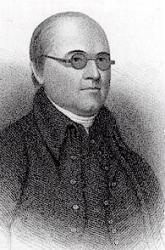
About Timothy Dwight
Timothy Dwight (1752–1817) was a towering figure in early American education, literature, theology, and hymnology. A grandson of the legendary theologian Jonathan Edwards, Dwight lived a multifaceted life as a Congregational pastor, a Revolutionary War army chaplain, a pioneering poet, and ultimately the transformative president of Yale College.
Operating at a time when the young American republic was facing a wave of secular deism and institutional decay, Dwight single-handedly sparked a massive spiritual and academic renaissance at Yale. Through this process, he gifted the global church with a landmark revision of Isaac Watts’s Psalter—including a timeless, elegant masterpiece that stands as the oldest surviving hymn written by an American that is still in widespread use today.
                      ┌──────────────────────────────────────┐
                      │    TIMOTHY DWIGHT'S SEEDED ROLES     │
                      └──────────────────┬──────────────────┘
                                         │
         ┌───────────────────────────────┼───────────────────────────────┐
         ▼                               ▼                               ▼
THE REVOLUTIONARY CHAPLAIN       THE ACADEMIC REFORMER           THE HYMNOLOGICAL PIONEER
Served under General Parsons;    As President of Yale (1795),    Commissioned in 1797 to rewrite
penned stirring patriotic        he defeated campus deism through  Watts's Psalter for an independent,
hymns for Continental soldiers.  rigorous, logical debate.       post-war American church.
The Child Prodigy and the Revolutionary Chaplain
Timothy Dwight was born on May 14, 1752, in Northampton, Massachusetts, into New England's intellectual aristocracy. A true child prodigy, he reportedly learned the alphabet in a single day, was reading the Bible fluently by age four, and entered Yale College at the astonishing age of thirteen. He graduated with high honors in 1769 and spent the next six years serving as a brilliant young tutor at the college.
When the American Revolutionary War erupted, Dwight threw his weight entirely behind the patriot cause. Armed with an intense, early American zeal, he was licensed to preach and formally entered the United States Army in 1777 as a chaplain for General Samuel Holden Parsons’s Connecticut brigade.
During his time on the frontlines, Dwight became a vital morale-booster for the Continental troops. He wrote powerful, driving patriotic songs and sermons designed to infuse the harsh realities of military encampments with biblical frameworks of liberty. Following the war, he relocated to Fairfield, Connecticut, where he spent twelve years establishing a nationally renowned co-educational academy while concurrently shepherding a prominent Congregational parish.
Transforming Yale: Defeating the "Triumph of Infidelity"
In 1795, Dwight was elected the eighth president of Yale College, an institution that had fallen into deep spiritual and structural decay. In the wake of the French Revolution, the student body had largely rejected orthodox Christianity, enthusiastically embracing French deism and skepticism. Students routinely called each other by secular nicknames like "Voltaire" and "Rousseau," and open Christian faith on campus had almost entirely vanished.
Rather than enforcing rigid, authoritarian dogma, Dwight adopted a brilliant strategy of fearless intellectual engagement. He invited the student body to bring forward their hardest, most cynical questions regarding the validity of the Bible and systematically faced them down in open, weekly debate forums. He combined these debates with a series of sweeping, logical chapel sermons that tore into what he called the "Triumph of Infidelity." His efforts triggered a historic campus revival in 1802, during which over half the student body experienced profound spiritual conversions. Dwight systematically upgraded the curriculum, established Yale's medical and theological departments, and firmly cemented the university's reputation as a premier hub for both cutting-edge academic science and deep spiritual fervor.
Americanizing Isaac Watts: The 1800 Psalter
Before Dwight’s work, early American churches relied almost entirely on the English hymn books of Dr. Isaac Watts. However, Watts's 1719 Psalter contained heavily localized, British-centric phrasing that felt entirely out of place in a newly independent, post-war American republic (featuring explicit prayers for the British King and references to Great Britain).
While an early 1785 revision was attempted by Joel Barlow, the General Association of Connecticut grew deeply dissatisfied with Barlow's personal theological shifts. In 1797, they officially commissioned Timothy Dwight to perform a complete, de novo overhauling of the book.
Dwight labored for three years, restoring missing psalms, stripping out British political references, and casting old texts into vibrant new meters. In 1800, he published the definitive collection:
The Psalms of David... By I. Watts, D.D. A New Edition in which the Psalms omitted by Dr. Watts are versified, local passages are altered, and a number of Psalms are versified anew... By Timothy Dwight, D.D.
Masterpiece: "I Love Thy Kingdom, Lord"
Among the 33 original, highly liberal metrical psalm paraphrases Dwight inserted into the 1800 collection, his third version of Psalm 137 rose above the rest to achieve permanent, universal immortality:
"I love Thy kingdom, Lord, the house of Thine abode!"
Lyrical and Structural Architecture
While Psalm 137 is historically a dark, mournful lament of Jewish exiles weeping by the rivers of Babylon ("How shall we sing the Lord's song in a strange land?"), Dwight completely transformed the text into a soaring, triumphant, New Testament declaration of absolute love for the corporate Church.
-
Stanza 1 (The Spiritual House): Establishes an immediate, first-person confession of love for the Church, identifying it explicitly as the "house of Thine abode" and the literal price of Christ's own blood.
-
Stanza 2 (The Divine Focus): Focuses on the absolute security of the Church, comparing it to the apple of God’s eye, engraved permanently upon the palms of His hands.
-
Stanza 3 (The Vow of Alignment): Offers a passionate pledge of loyalty. The singer declares that if they ever fail to prioritize the needs of the church, their own right hand should lose its skill.
Hymn Excerpt: The Supreme Allegiance
I love Thy Church, O God!
Her walls before Thee stand,
Dear as the apple of Thine eye,
And graven on Thy hand.
Set to the sturdy, elegant Short Meter (SM) tune ST. THOMAS (composed by Aaron Williams), the hymn spread rapidly across every denomination in the United States and was widely adopted by English, Scottish, and Irish hymnals—serving as a grand, unifying anthem of ecclesial identity.
The Solemn Warnings and Celebrated Verses
Dwight’s other original renderings from the 1800 project reflect his complex, dual nature as a writer: balancing intense, solemn warnings on human mortality with bright, jubilant songs of creation praise.
The Midnight Hour: Rendering Psalm 88
Reflecting the serious, introspective Calvinism of his grandfather, Jonathan Edwards, Dwight penned several hauntingly beautiful versions of Psalm 88 that deal directly with the brevity of human life and the critical urgency of repentance:
-
While life prolongs its precious light (Stanza 2): A stark, earnest appeal to seekers to embrace grace while they still draw breath.
-
Shall man, O God of life and light (Stanza 3): A deeply searching look into the grave, countered by the brilliant hope of the final resurrection.
The Jubilant Praises
Conversely, when handling the praise psalms, Dwight used a remarkably bright, expansive, and poetic vocabulary that mirrored his contributions to early American classical literature:
-
How pleasing is Thy voice (Psalm 65): A beautiful, rhythmic pastoral lyric celebrating God's goodness across the changing agricultural seasons.
-
Sing to the Lord most high (Psalm 100): A sweeping, joyous metrical version of the classic text of universal adoration.
Summary of Major Metric Paraphrases
| Hymn First Line / Core Text | Original Psalm Model | Tone & Liturgical Character |
| I Love Thy Kingdom, Lord | Psalm 137 (Version 3) | Soaring, devoted, ecclesial; an absolute classic of church identity. |
| While life prolongs its precious light | Psalm 88 (Version 2) | Solemn, urgent, awakening; a classic revival-era call to repentance. |
| How pleasing is Thy voice | Psalm 65 | Bright, scenic, creation-focused; highlighting natural providence. |
| Blest be the Lord, Who heard my prayer | Psalm 28 (Part 2) | Intimate, celebratory; a focused thanksgiving for delivered prayer. |
| In Zion's sacred gates | Psalm 150 | Triumphant, fast-metered; an expansive call to universal music worship. |
Timothy Dwight passed away on January 11, 1817, at sixty-four years of age, and was laid to rest in the historic Grove Street Cemetery in New Haven, Connecticut. Having spent his earthbound years systematically repairing the broken walls of his nation's premier college, his literary genius provided a newly born America with a clean, dignified, and scripturally sound voice, proving that the highest academic excellence and the deepest spiritual passion could sing in perfect harmony.