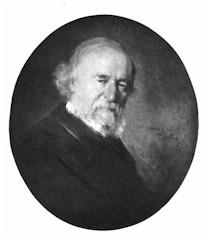
About Walter C. Smith
The Reverend Dr. Walter Chalmers Smith (1824–1908) was a distinguished Scottish divine, poet, and ecclesiast of the Victorian era who attained national prominence both as a leader within the Free Church of Scotland and as a prolific author of highly acclaimed verse. Born in Aberdeen on December 5, 1824, Smith received a rigorous classical education at the Grammar School and University of Aberdeen before pursuing his advanced theological training at Edinburgh. Over a long and influential career, his sharp intellect and deep spiritual warmth elevated him to influential pulpits, culminating in his historic appointment as the Moderator of the General Assembly of the Free Church of Scotland during its jubilee year in 1893.
While his expansive volumes of narrative poetry earned him a significant reputation in nineteenth-century literary circles, his permanent global legacy rests securely upon his majestic, transcendent masterpiece of objective praise, "Immortal, Invisible, God Only Wise."
A Brilliant Ministry Across Nations and Schisms
Walter Chalmers Smith entered the ministry during a period of immense theological and structural upheaval in Scottish church history. He was ordained on Christmas Day in 1850 as the pastor of the Scottish Church in Chadwell Street, Islington, London. After building a reputation in England for his robust, thoughtful preaching, he returned to Scotland to guide key congregations through the aftermath of the Disruption of 1843, a massive structural split that created the Free Church of Scotland.
Smith filled important pulpits in Milnathort, Roxburgh Free Church in Edinburgh, and the prominent Free High Church of Dundee. In 1876, his exceptional administrative capacity and pastoral brilliance resulted in a call to the historic Free High Church of Edinburgh, where he ministered to the intellectual and political elite of the capital city for decades. His profound contributions to the religious and academic life of Scotland were formally recognized with an honorary Doctor of Divinity degree, and his peers elected him to the highest ecclesiastical office as Moderator in 1893.
The Synthesis of Literature and Light
Throughout his demanding pastoral and administrative career, Dr. Smith maintained a highly productive second life as a serious literary poet. Writing both under his own name and under the protective pseudonym "Orwell," he published numerous multi-volume works of narrative and lyrical verse that explored the complex spiritual anxieties, doubts, and triumphs of the late Victorian mind. His major works included The Bishop's Walk (1860), Olrig Grange (1872), Borland Hall (1874), Hilda among the Broken Gods (1878), North Country Folk (1883), and Kildrostan (1884).
Hymnologists note that his sacred poetry was distinctly characterized by a rare combination of theological vigor and poetic grace, providing an objective, clear perspective on the nature of God that stood out against the overly subjective, emotional songs of his contemporaries. In 1867, he published his foundational collection, Hymns of Christ and the Christian Life, which introduced his unique voice to hymnal compilers across Great Britain.
                    ┌───────────────────────────────────────┐
                    │    DR. WALTER C. SMITH'S DUAL ACME    │
                    └───────────────────┬───────────────────┘
                                        │
         ┌──────────────────────────────┴──────────────────────────────┐
         ▼                                                             ▼
 ECCLESIASTICAL GIANT                                         TRANSFORMATIONAL TEXTS
 Moderator of the Free Church of Scotland                      Penned hymns of immense intellectual vigor,
 (1893); leader of major Edinburgh assemblies.                  including the global standard of public praise.
Landmark Masterpiece: "Immortal, Invisible, God Only Wise"
Dr. Smith's permanent, unshakeable contribution to global Christian worship was first published in his 1867 volume and subsequently revised for inclusion in W. Garrett Horder’s Congregational Hymns in 1884.
The Standard of Objective Adoration
The enduring genius of "Immortal, Invisible, God only wise" lies in its magnificent, cascading depiction of the classical divine attributes. Drawing heavily from the text of 1 Timothy 1:17, the hymn acts as a grand, sweeping defense of the transcendence and immutability of God. Smith masterfully contrasts the fragile, changing nature of human existence against the eternal, life-giving power of the Creator, using the metaphor of light to explain why God remains hidden from human eyes not due to darkness, but because the sheer, blinding intensity of His glory hides Him from mortal sight.
When paired with the triumphant, traditional Welsh melody ST. DENIO (originally adapted from an old folk song), the hymn achieved an unparalleled level of global adoption. It remains the definitive opening anthem for thousands of church assemblies, national festivals, and academic convocations throughout the English-speaking world.
Hymn Excerpt: The Splendor of Unapproachable Light
Immortal, invisible, God only wise,
In light inaccessible hid from our eyes,
Most blessed, most glorious, the Ancient of Days,
Almighty, victorious, Thy great Name we praise.
Great Father of glory, pure Father of light,
Thine angels adore Thee, veiling their sight;
All praise we would render; O help us to see
’Tis only the splendor of light hideth Thee!
Global Adaptations Across Linguistic Borders
Because Dr. Smith’s masterwork focused on the grand, unchanging attributes of God rather than localized cultural trends, his texts transitioned seamlessly across deep linguistic boundaries. Global missionaries immediately recognized that his verses gave newly established international communities an exceptionally strong, robust, and dignified vocabulary for public adoration.
| Language | Translated Regional Title / First Line | Core Theological Focus |
| Spanish |
Al Dios invisible, al Rey inmortal / Eterno, invisible, el Dios de poder |
The sovereign power, majesty, and unsearchable wisdom of the Father. |
| Portuguese | Deus sábio, invisível, perfeito, imortal | The absolute perfection and eternal nature of the divine character. |
| Chinese | 不能朽,不能見,獨一的真神 / 永生神就是靈 | The spiritual, incorruptible essence of God as the true source of light. |
| Malayalam | നിത്യനാം അരൂപി, ജ്ഞാനിയാം ദൈവം | Triumphant adoration of the invisible King who rules over all creation. |
Other Notable Hymnological Contributions
While his primary hymn dominates international usage, Dr. Smith contributed several other highly regarded texts that found their way into twentieth-century hymnals, primarily through The Baptist Church Hymnal (1900) and Thoughts and Fancies for Sunday Evenings (1887):
-
"One thing I of the Lord desire" – A deeply intimate hymn of consecration and personal holiness, detailing the Christian's desire for clean hands and a pure heart when traveling through a complicated world.
-
"I vexed me with a troubled thought" (Originally written as "There is no wrath to be appeased") – A thoughtful, comforting meditation on the absolute love of God, heavily revised by Smith himself to address the internal struggles of the human conscience.
-
"Earth was waiting, spent and restless" – A beautifully rhythmic Christmas anthem that illustrates the intense global longing and historical anticipation that preceded the Incarnation.
Death and Unfading Radiance
Following his retirement from active pastoral duties, Dr. Smith lived a quiet, highly respected life as one of Scotland’s grand old men of letters. He passed away peacefully on September 20, 1908, at eighty-three years of age, just as a collected edition of his extensive poetical works was securing his literary memory.
While his thick volumes of Victorian narrative poetry are now studied primarily by specialized historians of Scottish literature, Walter Chalmers Smith’s voice remains completely undimmed in global church life. Every time a congregation stands, lifts its eyes, and opens a service with those thunderous lines of adoration, the brilliant Moderator from Aberdeen continues to guide millions of voices straight into the presence of the King of Light.