About Walter Shirley
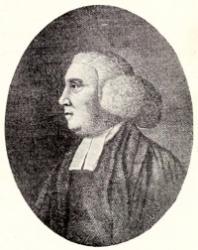
The Honorable Walter Shirley. Source: Wikipedia
The Honorable Walter Shirley (1725, 1786) was a prominent eighteenth century English clergyman, hymn writer, and poet who played a significant role in the Great Awakening and the early Methodist movement. Born into an aristocratic family, he was the fourth son of the Honorable Laurence Shirley and a grandson of the first Earl Ferrers. This noble lineage also made him a first cousin to Selina Hastings, the famous Countess of Huntingdon. Shirley combined his high social standing with a passionate commitment to evangelical revival, establishing close personal friendships with spiritual giants John Wesley, Charles Wesley, and George Whitefield, and frequently preaching within their shifting networks of societies and chapels.
Ministry in England and Ireland
Walter Shirley received a formal classical education and earned his Master of Arts degree before taking holy orders. He preached with immense success throughout England during the early days of the evangelical revival, drawing large crowds with his fervent and direct oratorical style. Later in his career, he accepted the church living of Loughrea in the county of Galway, Ireland, where he served as the local Rector for many years. Despite moving across the Irish Sea, Shirley maintained his close ties to the English revivalists, acting as a vital transatlantic bridge for evangelical theology during a time of significant cultural transformation.
Collaboration with the Countess of Huntingdon
Shirley is perhaps best remembered in hymnological history for his extensive literary assistance to his cousin, the Countess of Huntingdon. In 1774, he took on a leading role in compiling and thoroughly revising the official collection of hymns utilized across the congregations of her specific Methodist Connexion. Shirley contributed several of his own original poems to this influential collection, which was published around 1773. Beyond his editorial work, he was a passionate advocate for global missions, penning celebrated commemorative lines such as Go, destined vessel, heavenly freighted, go! in 1772 to mark the departure of missionaries traveling from the Countess's college to colonial America.
Architectural Contributions to Congregational Song
Shirley possessed a rare talent for both composing original verses and recognizing the hidden liturgical value in the rough drafts of his contemporaries. His editorial revisions frequently turned overlooked poems into timeless congregational favorites.
The Recast of Sweet the Moments
His most famous editorial achievement involves the popular hymn Sweet the moments, rich in blessing. The text was originally written by James Allen as a deeply personal meditation beginning with the line While my Jesus I'm possessing. Recognizing that the original language was somewhat clumsy for public worship, Shirley completely recast the stanzas, smoothing out the rhythm and elevating the imagery into a profound, accessible celebration of Christ's sacrifice. Similarly, his widely published dismissal anthem, Lord, dismiss us with Thy blessing, Fill our hearts with joy and peace, achieved unprecedented adoption across multiple denominations, serving as the definitive closing prayer for millions of worship services worldwide.
Hymn Excerpt: Meditation at the Cross
Sweet the moments, rich in blessing, Which before the cross I spend, Life and health and peace possessing From the sinner's dying Friend. Here I'll sit forever viewing Mercy's streams, in streams of blood; Precious drops, my soul bedewing, Plead and claim my peace with God.
Summary of Core Hymnological Repertoire
The historical catalog compiled by John Julian highlights several of Shirley's most enduring texts and editorial adaptations that remain in common use.
| Hymn Title / Common First Line | Original Publication Context | Primary Liturgical Theme | Notable Historical Variants |
|---|---|---|---|
| Lord, dismiss us with Thy blessing | Lady Huntingdon's Coll., c. 1773 | Benediction, corporate peace, and departing faith. | Appears in over ninety modern hymnals. |
| Sweet the moments, rich in blessing | Lady Huntingdon's Coll., c. 1773 | Devotional meditation on the crucifixion of Christ. | Recast from an original poem by James Allen. |
| Source of light and power divine | Lady Huntingdon's Coll., c. 1773 | Pre-sermon prayer for illumination and spiritual strength. | Frequently altered into shorter two stanza variants. |
| Sweet as the shepherd's tuneful reed | Lady Huntingdon's Coll., c. 1773 | Deep internal peace and relief from mental anxiety. | Stanzas two and three form Peace, troubled soul. |
| Worthy the Lamb of boundless sway | Lady Huntingdon's Coll., c. 1773 | Triumphant ascension praise and cosmic adoration. | Extracted from From heaven the loud angelic song began. |
Last Sickness and Sitting Pulpit
In his final years, Walter Shirley suffered from a lingering, painful illness that gradually stripped away his physical mobility. Showing the unyielding determination that characterized his early evangelistic career, he absolutely refused to silence his ministry. When he was no longer strong enough to leave his house or stand before a formal congregation, he turned his private drawing room into a makeshift chapel. Seated in an armchair, he regularly preached to dense crowds of local citizens who gladly packed his home to hear his final testimonies.
Walter Shirley passed away peacefully on April 7, 1786, at sixty-one years of age, leaving behind a published volume of popular sermons and two major theological poems, Liberty, an Ode and The Judgment. While his aristocratic titles and localized Irish rectorate are now preserved in historical registries, his voice remains beautifully vital. Every time a modern congregation stands to close its worship with his soaring benediction, the faithful cousin of the Countess continues to send travelers out into the world filled with joy and peace.