About William B. Tappan
William Bingham Tappan (1794–1849) was a prominent early nineteenth-century American Congregational minister, educator, and highly gifted religious poet who dedicated much of his professional life to the development of the early American Sunday School system. Born in Beverly, Massachusetts, on October 29, 1794, Tappan was initially apprenticed to a clockmaker in Boston in 1810, an experience that instilled in him a lifelong appreciation for order and precise detail. In 1815, he relocated to Philadelphia to engage in business, where his deep spiritual inclinations led him to pivot away from commercial secular trade and toward institutional church ministry.
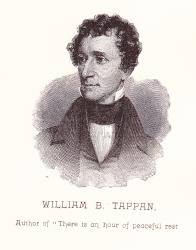
William Bingham Tappan (1794–1849). Source: Penny's poetry pages Wiki - Fandom
Tappan found his true administrative calling in 1822 when he was appointed as a Superintendent for the American Sunday School Union. In this vital role, he managed educational programs, coordinated regional resources, and advocated for the spiritual instruction of young people across the expanding nation. Seeking to expand his sphere of usefulness, he was formally licensed to preach by the Congregational ministry in 1840, allowing him to combine his educational oversight with dynamic evangelical preaching. His long, impactful career was cut tragically short when he died suddenly of cholera in West Needham, Massachusetts, on June 18, 1849.
Early Lyrical Work and Literary Architecture
William B. Tappan was a remarkably prolific author whose extensive poetical works include ten distinct collections published between 1819 and 1860. His earliest volumes, such as New England and Other Poems (1819) and Lyrics (1822), are widely considered his most textually significant contributions to American literature. Tappan wrote lyrics characterized by their delicate rhythmic flow, clear emotional sensitivity, and focus on the quiet assurance of divine grace, making his poetry highly attractive to contemporary hymnal editors.
His poetic output operated as an essential bridge for early American hymnody, helping transition church music away from rigid psalm translations and toward deeply expressive, personal devotions. His standard verses caught the attention of major international compilers and were frequently reprinted in major anthologies like the Lyra Sacra Americana, securing his status as one of the definitive American voices of his generation.
Landmark Masterpieces and Occasional Verses
Tappan's permanent place in global hymnody is anchored by two highly celebrated texts that showcase his mastery of contrasting emotional tones.
The Quiet Solitude of Gethsemane
His most widely utilized and enduring hymn is the deeply moving 1822 Passion text, "'Tis midnight; and on Olive's brow." Written to capture the profound, agonizing solitude of Jesus praying in the Garden of Gethsemane, the hymn uses rich sensory imagery to paint a vivid picture of the scene. By focusing on the dark shadows, the sleeping disciples, and the quiet presence of comforting angels, Tappan created a masterpiece of devotional realism that remains a standard staple for Holy Week and Good Friday services across hundreds of Protestant hymnals worldwide.
The Heavenly Hope of "There Is an Hour of Peaceful Rest"
In sharp contrast to his dark Gethsemane text, Tappan also achieved immense public popularity with his comforting 1818 poem, "There is an hour of peaceful rest." Originally written during a humid summer in Philadelphia for publication in the Franklin Gazette, the text was designed to offer absolute reassurance to souls suffering through earthly trials by pointing them toward the unshakeable peace of heaven. The piece was immediately pirated and reprinted across Great Britain and Europe, set to music by the prominent composer Anthony Philip Heinrich, and eventually adopted into more than four hundred corporate hymnals.
Hymn Excerpt: The Heavenly Rest
There is an hour of peaceful rest,
To mourning wanderers given;
There is a joy for souls distressed,
A balm for every wounded breast,
'Tis found above, in heaven.
There is a home for weary souls
By sin and sorrow driven;
When tossed on life's tempestuous shoals,
Where storms arise, and ocean rolls,
And all is drear but heaven.
Missionary Impact and the New Haven Wharf
Tappan's poetry also played a historic role in fueling the nineteenth-century global missionary movement. In 1822, he penned the stirring activist text, "Wake, isles of the south! your redemption is near," to celebrate the rapid expansion of Christian outreach in the Pacific.
The hymn achieved permanent historic significance when it was selected to be sung directly on the bustling shipping wharves of New Haven, Connecticut, during the official embarkation ceremony of the pioneering missionaries setting sail for the Sandwich Islands, known today as the Hawaiian Islands. This public performance established the hymn as a definitive anthem for early American cross-cultural missions.
Summary of Core Hymnological Contributions
| Hymn Title / Common Incipit | First Publication Context | Core Liturgical Theme | Historical Significance |
| 'Tis midnight; and on Olive's brow | Poems, 1822 | Gethsemane, Christ's passion, and divine suffering. | Appeared in over six hundred and twenty hymnals. |
| There is an hour of peaceful rest | Franklin Gazette, 1818 | Heavenly rest, comfort under trial, and eternity. | Set to music by A. P. Heinrich; over four hundred instances. |
| Wake, isles of the south! | Lyrics, 1822 | Global missions and prophetic fulfillment. | Sung at the New Haven wharf for departing missionaries. |
| There is an hour of hallowed peace | New England and Other Poems, 1819 | Spiritual rest, reassurance, and divine peace. | Maintained in one hundred early American collections. |
| The ransomed spirit to her home | Village Hymns, 1824 | Christian love, glorification, and the soul's journey. | Extolled by John Julian as perhaps his finest text. |
An Enduring Monument of Praise
Though his life was cut short by a sudden epidemic, William B. Tappan left behind a highly influential legacy that continues to touch congregations across the globe. His meticulous records for the American Sunday School Union helped build the structural foundation for early child education in the United States, proving that his faith was as practically organized as it was beautifully expressed.
While his specific clockmaker tools, local parish sermon drafts, and Union board minutes have faded into historical archives, his lyrical voice remains remarkably vital. Every time a congregation quietens its singing to contemplate the lonely midnight of Gethsemane, or raises its voice to find comfort in the promise of a peaceful rest beyond life's tempestuous shoals, the dedicated superintendent from Massachusetts continues to guide the song.