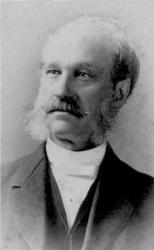
About William F. Sherwin
William Fisk Sherwin (1826–1888) was an exceptionally prominent nineteenth-century American composer, vocal teacher, and editor who played a foundational role in shaping the music of the American Sunday School movement. Born in Buckland, Massachusetts, Sherwin lacked extensive formal schooling but possessed a fierce determination and innate musical talent.
At the age of fifteen, he moved to Boston to study under Dr. Lowell Mason, the pioneer of American music education and church music. Under Mason's tutelage, Sherwin developed a robust, accessible musical style that would define his career. He eventually became a sought-after vocal instructor, holding important appointments across Massachusetts, in Albany and Hudson, New York, and ultimately in New York City.
Directing the Sound of Chautauqua and Sunday Schools
Sherwin’s enduring legacy is tied directly to his passion for children's religious education. During the late nineteenth century, the Sunday School movement underwent a massive expansion across America, shifting from quiet memorization spaces toward vibrant, community-centered assemblies. Sherwin recognized that children needed energetic, memorable, and joyful music rather than dense, complex adult theological hymns.
The historic Chautauqua assembly grounds. Source: ilbusca / Getty Images
His immense organizational talent caught the attention of John Heyl Vincent and Lewis Miller when they founded the famous Chautauqua Institution in western New York. Sherwin was appointed the very first musical director of the Chautauqua Assembly, establishing an influential tradition of massive choral sings, outdoor choruses, and community pageants that was emulated across the nation.
Major Hymnological Collaborations and Publications
Sherwin was a brilliant collaborator, regularly joining forces with the most prominent gospel lyricists and composers of his era, including the Reverend Robert Lowry. Together, they edited highly successful collections specifically designed for young voices.
-
Bright Jewels (1869): This landmark Sunday School collection became an immediate bestseller across denominations, blending bright rhythms with clear moral teaching.
-
Sacred Songs and Solos Integration: Sherwin's distinct, lively melodies eventually crossed the Atlantic. The famous American singing evangelist Ira D. Sankey selected several of Sherwin’s pieces for inclusion in his widely distributed British hymnbooks, cementing his international reputation.
Masterpieces of Spiritual Warfare and Celebration
While Sherwin occasionally penned lyrics under his initials "W. F. S.," his true mastery lay in composing unforgettable, martial, and celebratory musical arrangements.
                       ┌────────────────────────────────────────┐
                       │      SHERWIN'S TWIN MUSICAL MODES      │
                       └───────────────────┬────────────────────┘
                                           │
         ┌─────────────────────────────────┴─────────────────────────────────┐
         ▼                                                                   ▼
   THE MARCHING BATTLE CRY                                            THE TRANQUIL WATERWAYS
   • High-energy, brassy rhythms                                      • Gentle, rolling melodies
   • Designed for congregational unity                                • Designed for reflection and calm
   • Example: "Sound the battle cry!"                                 • Example: "Galilee, bright Galilee"
1. "Sound the Battle Cry!" (1869)
This remains Sherwin's most famous and widely utilized composition. Written as a rallying anthem for spiritual courage and Christian warfare, the song uses bold, military-style cadences to engage young singers. The triumphant chorus became a staple of youth rallies for over a century:
Sound the battle cry! See, the foe is nigh;
Raise the standard high for the Lord;
Gird your armor on, stand firm every one;
Rest your cause upon His holy Word.
2. "Galilee, Bright Galilee" (1870s)
In stark contrast to his military marches, this composition showcases Sherwin's ability to craft extraordinarily tender, flowing melodies. The piece captures the serene atmosphere of the biblical Lake of Gennesaret, utilizing smooth, wave-like phrasing that made it a beloved classic in over fifty major hymnals.
Notable Works and Thematic Contributions
| Hymn Title / Incipit | Primary Creative Role | Core Thematic Focus | Notable Historical Impact |
| Sound the battle cry! | Composer (Tune) | Spiritual warfare, courage, and unity. | Found in over 240 hymnals; translated globally into German and Portuguese. |
| Galilee, bright Galilee | Composer & Author | The life and ministry of Jesus by the sea. | Highly successful programmatic piece with 57 major hymnal appearances. |
| Lo! the day of God is breaking | Author & Composer | Evangelism, spiritual awakening, and duty. | Widely adopted for missionary and revival assemblies. |
| Grander than ocean's story | Author & Composer | The infinite scope of divine love. | Frequently chosen for major Sunday School anniversary celebrations. |
A Final Return to Boston
After decades of traveling, teaching, and conducting massive festival choirs across the United States, William Fisk Sherwin spent his final years returning to his roots in Massachusetts. He passed away in Boston on April 14, 1888, at the age of sixty-two. Through his simple, brilliant melodies, he successfully gave a musical voice to a generation of young students, ensuring that the American Sunday School would remain a place of vibrant, joyous song.