About Aurelius Clemens Prudentius
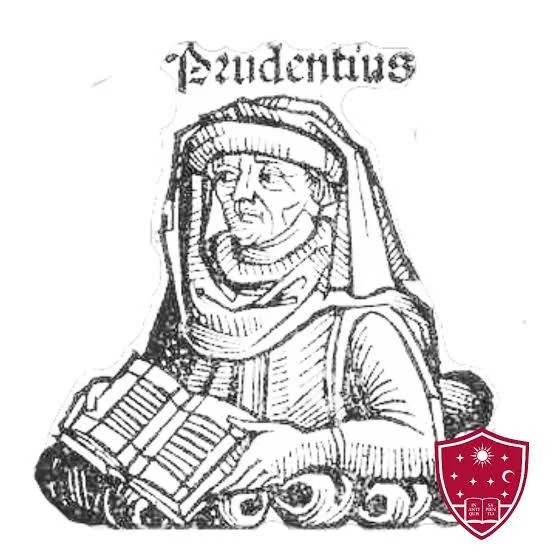
Aurelius Clemens Prudentius (c. AD 348–410/413) was the foremost Latin Christian poet of the early Church and is often regarded as the greatest Christian poet of late antiquity. Frequently called "the Christian Pindar" and even described by some scholars as the "Horace and Virgil of the Christians," he played a pivotal role in bridging the literary culture of classical Rome with the emerging Christian civilization of the Middle Ages. Although his poems were not originally written for congregational singing like those of Ambrose of Milan, many of them were later adapted into the liturgy of the Western Church, making him one of the most influential figures in the history of Christian hymnody.
Born around AD 348 in northern Spain, probably in Calahorra, Zaragoza, or Tarragona, Prudentius received an excellent classical education and trained as a lawyer. He enjoyed a distinguished career in public service, first practicing law and later serving as governor or judge over two important cities before being promoted to a higher office in the imperial civil administration. His own writings describe his faithful administration of justice and his advancement under the favor of the emperor. Yet despite his success, Prudentius eventually became deeply aware of the emptiness of worldly ambition and the fleeting nature of earthly honors.
At approximately fifty-seven years of age, Prudentius underwent a profound spiritual turning point. Convinced that the pursuit of public office and worldly recognition could never satisfy the eternal soul, he resigned from government service and devoted the remainder of his life to Christ. Unlike Augustine of Hippo, whose conversion followed a life of open moral rebellion, Prudentius viewed his greatest failures as worldliness, misplaced priorities, and an excessive attachment to temporal success. He chose a life of relative poverty and quiet devotion, resolving to use his literary gifts in the service of the Church rather than the empire.
The fruit of this decision was an extraordinary body of Christian poetry that profoundly shaped Western Christianity. His principal works include the Cathemerinon, a collection of hymns for various hours of the day and major Christian festivals; the Peristephanon, poems celebrating the courage and faith of Christian martyrs; the Apotheosis, a defense of Christ's divine nature; Hamartigenia, a theological poem on the origin of sin written against Marcionite error; the Psychomachia, an allegory depicting the spiritual battle between virtues and vices; Contra Symmachum, defending Christianity against pagan efforts to restore the Altar of Victory in Rome; and the Dittochaeon, a series of short poems illustrating scenes from both the Old and New Testaments.
Among these works, the Cathemerinon and the Peristephanon became especially influential in Christian worship. Though originally composed as literary poetry, portions of these collections were adapted into the Mozarabic Rite and later incorporated into medieval breviaries throughout the Western Church. Several beloved hymns, including "Of the Father's Love Begotten", derive from Prudentius's writings and continue to be sung by Christians more than fifteen centuries after they were first composed. His poetry thus became a lasting bridge between the devotional life of the ancient Church and the hymn traditions of the medieval and modern eras.
Prudentius wrote during a period of significant transition in Latin literature. Classical poetic forms were declining, while the rhythmic and rhyming style that would characterize medieval hymnody had not yet fully emerged. His poetry reflects both worlds: it preserves much of the dignity and richness of classical Latin while pioneering new ways of expressing Christian doctrine and devotion. Although some critics have noted occasional rhetorical excess or uneven style, his best poetry displays remarkable theological depth, vivid imagery, and heartfelt piety. His Psychomachia, in particular, became one of the most influential allegorical works of the Middle Ages, inspiring generations of Christian writers, artists, and theologians with its portrayal of the spiritual conflict between virtue and vice.
The exact date of Prudentius's death is unknown, though most scholars place it around AD 410–413. His legacy endures as one of the foundational voices of Christian Latin literature. By employing the literary excellence of the classical world to proclaim biblical truth, Prudentius demonstrated that the Christian faith could inspire works of enduring artistic beauty as well as profound theological significance. His writings not only enriched the worship of the Church but also helped shape Christian thought, devotion, and hymnody for centuries to come.