About Priscilla J. Owens
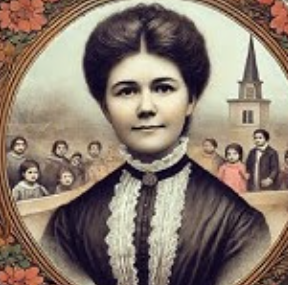
Priscilla Jane Owens (1829–1907) was an influential 19th-century American hymnwriter and dedicated educator whose lifelong ministry within the Sunday School movement yielded some of evangelicalism's most enduring, joyful anthems. Of Scottish and Welsh descent, Owens spent her entire 78 years in Baltimore, Maryland, where she balanced a demanding 49-year career as a public school teacher with an incredibly active spiritual life at the Union Square Methodist Episcopal Church.
Because her primary focus was children's education, she possessed a rare gift for translating weighty, complex theological concepts into vivid, rhythmically infectious verses that children could easily memorize and sing with enthusiasm.
Dual Masterpieces: The Anchored Soul and the Mission Call
While Owens published dozens of hymns in religious periodicals like the Methodist Protestant and the Christian Standard, her global legacy rests securely on two masterpieces that approached Christian life from entirely different angles: steadfast endurance and triumphant outreach.
1. "Will Your Anchor Hold in the Storms of Life" (1881)
Written for a Sunday School assembly, this hymn utilizes powerful, dramatic maritime imagery to explore the certainty of faith amidst suffering. Set to a stirring, robust melody and refrain by William J. Kirkpatrick, the song became an absolute phenomenon, particularly within Great Britain.
It was adopted as the official international anthem of The Boys' Brigade (a pioneering Christian youth organization founded in Scotland in 1883), anchoring the spiritual identity of millions of young men across the British Empire. The chorus remains a cornerstone of congregational singing:
"We have an anchor that keeps the soul Steadfast and sure while the billows roll, Fastened to the Rock which cannot move, Grounded firm and deep in the Savior’s love."
2. "We Have Heard a Joyful Sound" ("Jesus Saves!") (1882)
Composed specifically for a Sunday School Missionary Anniversary, this text is one of the most explosive, fast-paced missionary anthems ever written. The structural origin of the song is a fascinating piece of musical adaptation: Owens custom-fit her words to the complex, driving rhythm of "Vive le Roi" ("Long Live the King"), a famous chorus from the grand French opera Les Huguenots by Giacomo Meyerbeer.
Kirkpatrick adapted the operatic framework into a highly accessible, standard gospel tune (appropriately named JESUS SAVES), creating a sweeping wave of sound where the central, two-word declaration punctuates nearly every single line:
"Waft it on the rolling tide: Jesus saves! Jesus saves! Tell to sinners far and wide: Jesus saves! Jesus saves! Sing, ye islands of the sea; echo back, ye ocean caves; Earth shall keep her jubilee: Jesus saves! Jesus saves!"
The Educational Legacy: "Give Me the Bible"
As a career schoolteacher, Owens understood that a child's moral and spiritual development required a deep love for the scriptures. In 1883, she penned "Give Me the Bible," a bright, optimistic hymn designed to make scripture memory and study appealing to young minds. Paired with a energetic, bouncy tune by John R. Sweney, the hymn portrays the Bible not as a cold book of rigid rules, but as a warm, comforting beacon of light:
"Give me the Bible, star of gladness gleaming, To cheer the wanderer lone and tempest tossed; No storm can hide that peaceful radiance beaming, Since Jesus came to seek and save the lost."
Owens passed away on December 5, 1907, just as the hymns she had written for a localized Baltimore Sunday School were cementing their status as permanent, global standards. Her unique legacy bridges the gap between the schoolroom and the sanctuary, proving that the most profound theological truths are often those written simply enough for a child to sing.