About R. E. Hudson
Ralph E. Hudson (1843–1901), born Ralph Erskine Hudson, was a dynamic force in the late 19th-century American gospel music movement. A veteran of the Civil War, an academic, an evangelist, and a prominent music publisher, Hudson possessed a brilliant knack for creating simple, emotionally powerful, and heavily rhythmic music.
Beyond writing his own songs, he became famous for taking older, subdued traditional hymns and pairing them with brand-new, energetic camp-meeting choruses—a technique that fundamentally changed how congregations sang across America.
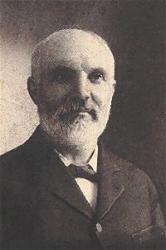
Ralph Erskine Hudson. Source: Hymndex
From the Battlefields to the Classroom
Hudson was born on July 9, 1843, in Napoleon, Ohio. When the American Civil War broke out, he enlisted in the Union Army, serving faithfully in Company I of the 10th Ohio Volunteer Infantry. Following his honorable discharge, his sharp intellect and musical abilities led him to Mt. Union College in Alliance, Ohio, where he served as a professor of music for five years.
During his time in Alliance, Hudson’s passion for grassroots spiritual renewal grew. He became deeply embedded in the Methodist Episcopal Church, eventually being licensed as a local preacher. Recognizing that the rapidly expanding Sunday School and revival movements required a constant stream of fresh, affordable music, he left academia in the late 1870s to establish his own independent music publishing house.
The Publisher and Reformer
Operating out of Alliance, Hudson became a highly successful compiler and distributor of sacred songbooks. He was also a passionate social reformer and a radical prohibitionist. He threw his musical weight into the temperance movement—the social crusade against alcohol consumption—publishing The Temperance Songster in 1886. This collection provided anti-saloon activists and families with rousing, moral songs to sing at rallies and marches across the country.
Iconic Hymnic Contributions
Hudson's legacy in global hymnology rests on three towering achievements:
1. The Dynamic Chorus for Isaac Watts' "Alas! and Did My Savior Bleed" ("At the Cross")
In 1885, Hudson published a collection titled Gospel Voices. In it, he took Isaac Watts' deeply somber 1707 Holy Week hymn, "Alas! and Did My Savior Bleed," and revolutionized it. He wrote a bright, soaring, and triumphant refrain to be sung between Watts' verses, completely altering the mood of the piece from quiet grief to ecstatic victory.
He paired this text with his own bouncy, memorable melody (HUDSON). This combined version, universally known as "At the Cross," became an immediate global phenomenon:
Chorus: "At the cross, at the cross where I first saw the light, And the burden of my heart rolled away, It was there by faith I received my sight, And now I am happy all the day!"
2. The Tune for Clara Tear Williams' "Satisfied" (1875)
Hudson possessed a rare empathy for other writers' texts. When Ohio hymnwriter Clara Tear Williams penned her deeply personal poem about spiritual peace, "All My Life Long I Had Panted," Hudson recognized its potential. He composed a beautifully tender, flowing melody and a joyful refrain that perfectly matched her words. The resulting hymn, "Satisfied," became a mainstay of late-19th-century holiness revivals.
3. Arranging "Blessed Be the Name"
In 1887, Hudson took a classic, stately 18th-century text by Charles Wesley ("O for a Thousand Tongues to Sing") and streamlined it for mass camp meetings. He arranged a rhythmic, infectious camp-meeting chorus—"Blessed be the name, blessed be the name, blessed be the name of the Lord!"—marrying it to an old folk melody. This arrangement remains one of the most widely recognized praise choruses in the evangelical tradition.
Death and Legacy
In his later years, Hudson relocated his publishing efforts to Cleveland, Ohio. While traveling in the midst of a vigorous music-ministry tour, he passed away suddenly on June 14, 1901, in Upland, Indiana.
Though he wrote many original verses, Hudson's unique genius lay in his ability to act as a musical bridge. He understood that while old hymn texts held deep theological gold, they often needed a fresh, vibrant, and accessible musical vehicle to truly capture the hearts of the common people. Through his publishing savvy and his infectious melodies, he helped give American corporate worship its distinctly joyful, participatory character.