About Ray Palmer
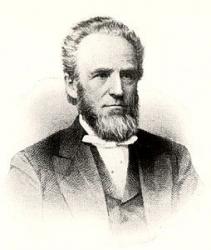
Ray Palmer (1808–1887) is widely celebrated as one of the finest and most intellectually refined American hymn writers of the 19th century. A Congregational minister by trade, Palmer achieved international renown for combining deep theological thought, elegant poetic phrasing, and intense personal devotion.
Unlike many of his contemporaries who wrote thousands of rapid-fire gospel songs, Palmer focused on quality over quantity. His legacy rests on a foundational body of deeply introspective verses and brilliant translations of ancient Latin texts that are still sung globally today.
From Store Clerk to Academic Minister
Born on November 12, 1808, in Little Compton, Rhode Island, Palmer was the son of a prominent local judge. His early life, however, was modest. After grammar school, he moved to Boston to work as a clerk in a dry-goods store. It was during this time that he experienced a profound religious awakening at the Park Street Congregational Church.
Driven by a new calling to the ministry, Palmer spent three years at Phillips Academy in Andover, Massachusetts, before entering Yale College, where he supported himself by teaching and graduated in 1830. He was formally ordained in 1835 and enjoyed a highly successful ministerial career:
-
Central Congregational Church (Bath, Maine; 1835–1850)
-
First Congregational Church (Albany, New York; 1850–1865)
-
American Congregational Union (Corresponding Secretary; 1865–1878)
The Tears Behind an International Masterpiece
In 1830, fresh out of Yale and working as a young teacher in New York City, Palmer fell into a period of deep loneliness, ill health, and spiritual trial. Sitting alone in his room, he felt compelled to write down his personal feelings of surrender and trust in Christ.
He penned four stanzas of eight lines each in a small notebook. As he later recalled:
"I gave form to what I felt, by writing, with little effort, the stanzas. I recollect I wrote them with very tender emotion, and ended the last line with tears."
He tucked the poem away in his pocket, completely unaware that he had just written one of the most famous hymns in human history: "My Faith Looks Up to Thee."
The Breakthrough: Meeting Lowell Mason
A year later, Palmer happened to run into the legendary American music educator and composer Dr. Lowell Mason on a street in Boston. Mason mentioned that he and Thomas Hastings were compiling a new songbook and needed high-quality texts. Palmer reached into his pocket and handed him the tear-stained poem.
A few days later, Mason ran into Palmer again and made a stunning prediction:
"Mr. Palmer, you may live many years and do many good things, but I think you will be best known to the world as the author of 'My Faith Looks Up to Thee.'"
Mason composed the majestic, steady tune OLIVET specifically for Palmer's words. Published in 1831 in Spiritual Songs for Social Worship, the hymn spread like wildfire across English-speaking countries and was translated into dozens of languages, including a classical Latin rendering ("Fides Te mea spectat").
"My faith looks up to Thee, Thou Lamb of Calvary, Savior divine! Now hear me while I pray, Take all my guilt away, O let me from this day Be wholly Thine!"
Master of the Latin Translation
In 1858, professors at Andover requested Palmer's help in creating the influential Sabbath Hymn Book. This request triggered a brilliant new phase in Palmer's writing career. He turned his classical academic training toward the ancient Latin hymns of the early church, translating them into elegant, singing English.
His translated masterpieces are considered among the absolute best in the English language, matching the lyrical grace of John Mason Neale:
-
"Jesus, Thou Joy of Loving Hearts" (1858): A breathtaking translation of a portion of the famous 12th-century Latin poem Jesu dulcis memoria (traditionally attributed to Bernard of Clairvaux). Palmer took the medieval, mystical longing for Christ and turned it into a smooth, accessible communion standard.
-
"O Bread to Pilgrims Given" (1858): A translation of the classic eucharistic Latin hymn O esca viatorum.
-
"Come Holy Ghost, in Love" (1858): An exceptionally tender translation of the 13th-century golden sequence, Veni Sancte Spiritus.
Beyond "My Faith Looks Up to Thee," Palmer contributed several other highly regarded original hymns that filled denominational books throughout the late 19th and 20th centuries:
-
"Jesus, These Eyes Have Never Seen" (1858): A beautifully poetic meditation on loving a Savior who remains physically unseen, often ranked by hymnologists as second only to his first masterpiece.
-
"O Bread to Pilgrims Given" and "O Jesus, Sweet the Tears I Shed" (1867) (a poignant Good Friday hymn).
-
"O Rock of Ages, Since on Thee" (1869): A hymn on structural faith so robust that British Bishop Edward Bickersteth declared it "worthy of Martin Luther."
After retiring from active organizational ministry in 1878, Dr. Palmer spent his quiet twilight years in Newark, New Jersey, where he passed away on March 29, 1887, at the age of 78.
While he published numerous books of prose, theological textbooks, and grand collections of verse during his lifetime, history proved Lowell Mason entirely correct: Palmer is immortalized because of a deeply personal poem he wrote with tears in his eyes as an anxious 22-year-old teacher.