About Robert Lowry
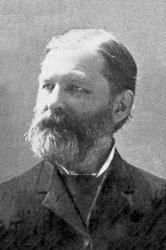
Dr. Robert Lowry (1826–1899) was one of the most towering and versatile giants of the 19th-century American Gospel Song movement. A brilliant, highly educated Baptist minister and university professor, Lowry viewed himself first and foremost as a preacher of the pulpit. Yet history remembers him as a musical "spinning machine" a genius who composed both the words and melodies to some of the most universally recognized anthems in Christendom.
The Pulpit and the University
Born in Philadelphia on March 12, 1826, Lowry displayed an innate obsession with musical instruments as a child. However, feeling a distinct call to pastoral ministry at age 22, he entered the University of Lewisburg (now Bucknell University) in Pennsylvania. He graduated in 1854 with the highest honors of his class and immediately began a highly successful career pastoring prominent congregations in New York City, Brooklyn, and Plainfield, New Jersey.
Lowry was an exceptional orator, lauded for his deep theological insight, a sharp sense of humor, and an uncanny ability to paint vivid, emotional pictures with his spoken words. In 1869, he returned to his alma mater as a Professor of Belles-Lettres (Rhetoric and Literature), later receiving an honorary Doctor of Divinity degree.
The "Spinning Machine" of Melody
Though Lowry insisted that music was merely a side hobby and a form of recreation, melodies constantly flooded his mind. He famously told a reporter:
"My brain is a sort of spinning machine, I think, for there is music running through it all the time... I watch my moods, and when anything good strikes me, whether words or music, and no matter where I am, at home or on the street, I jot it down. Often the margin of a newspaper or the back of an envelope serves as a notebook."
A meticulous academic, Lowry built one of the finest private musical science libraries in the United States. He even spent months attempting a massive mathematical project to reduce musical composition to a rigid arithmetic formula using sound wave vibrations, abandoning the experiment only when he proved to himself that true musical art defies pure mathematics.
Landmark Compositions
Lowry wrote the lyrics, the music, or both for an astonishing number of historic gospel songs. His catalog includes:
1. "Shall We Gather at the River?" (1864)
Written in Brooklyn on an oppressively hot summer day during a devastating disease epidemic, Lowry sat at his parlor organ to process the grief of parting with dying friends. The words and music poured out of him in a sudden wave of inspiration. Ironically, Lowry didn't think highly of the tune, dismissively calling it "brass band music with a march movement." Yet, it became a global phenomenon, sung by 40,000 children at a single rally in Brooklyn and earning him a standing ovation from international delegates at the Old Bailey in London.
2. "Low in the Grave He Lay" (Up from the Grave He Arose) (1874)
Lowry captures the dramatic contrast of Easter morning by utilizing a slow, somber, minor-key verse to depict Christ in the tomb, which abruptly erupts into a fast-paced, triumphant, brassy major-key chorus: "Up from the grave He arose, with a mighty triumph o'er His foes!"
3. "What Can Wash Away My Sin?" (Nothing but the Blood of Jesus) (1877)
A masterclass in rhythmic simplicity, this foundational gospel hymn uses a direct, driving call-and-response structure that made it instantly teachable to massive revival congregations.
4. The Famous Collaborations
In addition to his own written works, Lowry served as the chief music editor for the massive publishing house Biglow & Main (succeeding William B. Bradbury). Collaborating with William H. Doane, Lowry edited historic Sunday School songbooks like Pure Gold and Royal Diadem, which sold millions of copies worldwide. During this era, Lowry composed the legendary melodies for texts written by his close friend, Fanny Crosby, including:
-
"All the Way My Saviour Leads Me"
-
"I Need Thee Every Hour" (Lyrics by Annie S. Hawks, tuned by Lowry)
-
"We're Marching to Zion" (Lyrics by Isaac Watts, tuned by Lowry)