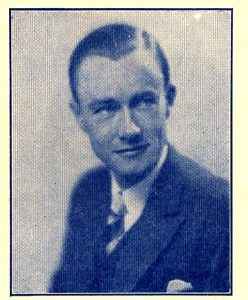
About Robert MacGimsey
Robert MacGimsey (1898–1979) was an American composer, singer, and lawyer whose life’s work was dedicated to preserving, documenting, and honoring the musical traditions of African American spirituals. Though he was a white man born into the deeply segregated post-Reconstruction American South, MacGimsey used his classical training to translate the rich, oral folk music of Black communities onto the written page. In doing so, he composed one of the most hauntingly beautiful and enduring Christmas anthems in modern history.
A Dual Legacy: Law and Music
Born in Pineville, Louisiana, on September 23, 1898, MacGimsey grew up immersed in the distinct soundscape of the rural South. As a child, he was deeply moved by the songs he heard sung by African American farmworkers and families in his community. He learned to replicate the complex vocal inflections, microtones, and unique whistling techniques common to the tradition.
Despite his intense love for music, MacGimsey initially pursued a traditional professional path:
-
The Legal Career: He studied law and successfully entered the legal profession, eventually securing a position as a secretary to a U.S. Senator in Washington, D.C.
-
The Musical Pivot: The pull of music proved too strong. He eventually resigned from his legal career to study classical composition and voice at the Institute of Musical Art (now the Juilliard School) in New York City.
The Masterpiece: "Sweet Little Jesus Boy" (1934)
MacGimsey’s most significant contribution to hymnology came on a winter night in 1932. As he walked through the crowded, flashing streets of New York City during the Christmas season, he noticed a stark contrast between the commercialized, boisterous holiday celebrations taking place in the city's affluent districts and the quiet, impoverished conditions of local minority communities.
Moved by this disparity, MacGimsey sought to write a song that captured the true, humble essence of the Nativity through the lens of a traditional spiritual.
Published in 1934, "Sweet Little Jesus Boy" mimics the style of an authentic, un-metered spiritual. It is written as an emotional apology to the newborn Savior, lamenting that humanity failed to recognize Him when He arrived in a lowly manger:
"Sweet little Jesus Boy, they made You be born in a manger. Sweet little Jesus Boy, we didn't know who You were. Didn't know You'd come to save us, Lord; to take our sins away. Our eyes were blind, we couldn't see, we didn't know who You were."
Because MacGimsey wrote the piece with such stylistic accuracy, deep emotional reverence, and structural simplicity, many listeners mistakenly assume it is an anonymous folk spiritual passed down from the era of slavery. Instead, it is an entirely original art song composed to honor that specific tradition.
Beyond the Manger: Global Impact
MacGimsey became a prominent concert performer, traveling extensively to sing and lecture on the historical value of spirituals. He was highly regarded for his remarkable vocal range and his rare ability to whistle two-part harmony simultaneously.
"Sweet Little Jesus Boy" crossed cultural and denominational boundaries to become a staple of American choral music. It achieved legendary status through definitive recordings by iconic African American vocalists who recognized the song's genuine spirit, including:
-
Mahalia Jackson – Whose deep, soulful rendition made the song a global Christmas classic.
-
Marian Anderson – Who brought her world-renowned operatic contralto voice to MacGimsey’s delicate phrasing.
-
The Staple Singers – Injecting the song with the foundational rhythms of the Civil Rights era gospel movement.
MacGimsey spent his later years in total devotion to music, eventually returning to the South where he passed away in March 1979. His manuscripts, field notes, and recordings remain preserved in university archives as an invaluable record of early American folk hymnology.