About Robert Southwell
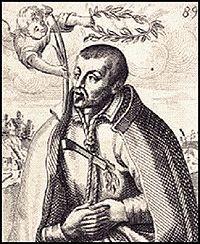
Saint Robert Southwell (c. 1561–1595) was a Jesuit priest, undercover missionary, and one of the most brilliant poets of the Elizabethan era. Operating in an age when practicing the Catholic faith in England was a capital crime, Southwell lived a dangerous clandestine life, dodging spy networks to minister to hunted believers. His vivid, intensely emotional verse—fusing Baroque imagery with deep theological devotion—not only provided comfort to an underground church but also profoundly shaped the course of English metaphysical poetry.
The Call of the Underground Mission
Born to a prominent family at Horsham St. Faith, Norfolk, around 1561, Southwell was sent abroad as a boy to receive a Catholic education in Paris and Rome. Deeply drawn to the spiritual discipline of the Counter-Reformation, he entered the Society of Jesus (the Jesuits) in Rome in 1578. He proved to be a brilliant scholar and was ordained a priest in 1584.
At the time, Queen Elizabeth I's government viewed any English subject ordained abroad as a traitor. Despite the absolute certainty of torture and execution if caught, Southwell actively volunteered for the English Mission. He slipped across the English Channel in disguise in 1586, adopting the pseudonym "Cotton."
For six years, Southwell traveled in secret under the noses of the Crown's notorious priest-hunters. He found a base of operations in London as the private chaplain to the Countess of Arundel, whose husband was imprisoned in the Tower. Moving softly through the shadows, he composed a series of masterful prose tracts and poems to steel the resolve of English recusants (those refusing to attend Anglican services).
The Crucible of Early Metaphysical Poetry
Southwell believed that poetry’s true purpose had been corrupted by secular romance and "folly." He sought to reclaim the art form to express the raw, blazing intensity of divine love. His work relies heavily on bold, shocking conceits (extended metaphors) and paradoxes, bridging the gap between classical renaissance structure and the later metaphysical styles of John Donne and George Herbert.
His most famous compositions include:
1. "The Burning Babe"
Universally recognized as his masterpiece, this striking Christmas poem describes a visionary encounter on a freezing winter night. Ben Jonson, one of the greatest dramatists of the age, famously remarked to William Drummond that he would gladly have destroyed many of his own poems just to have written "The Burning Babe."
In the poem, the Christ child appears suspended in the air, glowing with a consuming fire that symbolizes his sacrificial love for humanity:
"The fuel Justice layeth on, and Mercy blows the coals,
The metal in this furnace wrought are men's defiled souls,
For which, as now on fire I am to work them to their good,
So will I melt into a bath to wash them in my blood."
2. "Behold a Silly Tender Babe"
Another exquisite piece written for Christmastide, this text employs the word "silly" in its original Elizabethan sense—meaning helpless, simple, or innocent. It highlights the profound humility of the Incarnation, contrasting the vulnerability of an infant in a cold stable with the cosmic sovereignty of God.
3. Hymnal Translations
Southwell was also a skilled translator of liturgical Latin. He rendered portions of Thomas Aquinas's majestic Corpus Christi sequence, Lauda Sion Salvatorem ("Praise, O Sion, praise thy Savior"), into English verse, preserving its intricate theological precision for his underground flock.
Southwell’s covert ministry came to an end in 1592. Betrayed by an informant, he was arrested at a house in Harrow and handed over to Elizabeth's chief torturer, Richard Topcliffe. Southwell was subjected to brutal torture in Topcliffe's private residence and kept in solitary confinement in the Tower of London for nearly three years, yet he consistently refused to name a single fellow Catholic.
On February 21, 1595, Southwell was brought to Westminster for a formal trial and convicted of high treason. The following day, February 22, he was taken to Tyburn, where he was executed by hanging, drawing, and quartering. Throughout his ordeal, he maintained a serene, forgiving demeanor that deeply moved the watching crowd.
His poetry, compiled and published shortly after his martyrdom, went through multiple secret editions. Centuries later, in 1970, Southwell was officially canonized by Pope Paul VI as one of the Forty Martyrs of England and Wales.