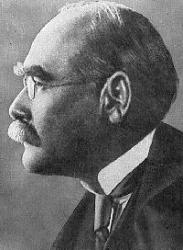
About Rudyard Kipling
Rudyard Kipling (1865–1936) is universally celebrated as a titan of English literature, famous for his short stories, poems, and novels that captured the peak and the complex psychological undercurrents of the British Empire. The first English-language writer to receive the Nobel Prize in Literature (1907), Kipling is primarily remembered for beloved works like The Jungle Book and Kim. However, his sharp lyrical precision also yielded a small, remarkable contribution to Christian hymnody—most notably a solemn masterpiece that served as a prophetic warning against national arrogance and imperial overreach.
A Global Life Framed by Empire
Born on December 30, 1865, in Bombay (now Mumbai) in nineteenth-century British India, Kipling was deeply shaped by the dualities of his childhood. He spent his early years immersed in Indian language and culture, before being sent to England at age five for a structured, often painful British schooling.
His complex relationship with the concept of empire defined his life's work. As a journalist, poet, and novelist traveling between India, England, South Africa, and the United States, Kipling was a passionate believer in the civil duty of the British Empire, yet he remained an incredibly sharp observer of its fatal flaws, internal hubris, and eventual decline.
The Story Behind "The Recessional"
Kipling’s primary entry into hymnology is "The Recessional" (frequently titled by its opening line, "God of our fathers, known of old").
In the summer of 1897, the British Empire gathered to celebrate the Diamond Jubilee of Queen Victoria, marking her 60th year on the throne. The atmosphere in London was one of unparalleled, intoxicating triumphalism. Fleet ships packed the harbors, military parades marched down the avenues, and the public mood was filled with a sense of permanent global dominance.
Amid this intoxicating celebratory atmosphere, The Times approached Kipling to write a commemorative poem. Rather than delivering a predictable piece of patriotic flattery, Kipling penned an astonishingly somber, prayerful warning.
Kipling's final resting place in Poets' Corner, Westminster Abbey. Source: Westminster Abbey
Drawing heavily on Old Testament prophetic language (particularly the warnings to ancient Israel about forgetting God in times of wealth), Kipling reminded his country that all human empires are temporary. He noted that without a foundational reverence for divine justice, Britain's massive navies and global power would eventually vanish into the dust, just like Nineveh and Tyre:
"The tumult and the shouting dies; The Captains and the Kings depart: Still stands Thine ancient sacrifice, An humble and a contrite heart. Lord God of Hosts, be with us yet, Lest we forget—lest we forget!"