About Samuel Johnson
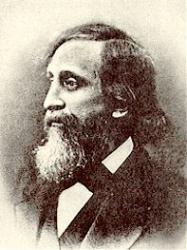
Samuel Johnson (1822–1882) was an American clergyman, hymnist, and scholar whose independent religious convictions and literary contributions left a distinct impression on nineteenth-century American hymnody. Born in Salem, Massachusetts, on October 10, 1822, he completed his formal education at Harvard University, graduating from the college in arts in 1842 and from the Harvard Divinity School in 1846. Deeply individualistic in his theology, Johnson never formally aligned himself with any single religious denomination, though his thought and works were primarily linked with the Unitarian movement and the broader Transcendentalist circle. In 1853, he founded an independent Free Church in Lynn, Massachusetts, serving as its pastor until 1870. He spent his remaining years in scholarly retirement before passing away in North Andover, Massachusetts, on February 19, 1882.
Throughout his career, Johnson maintained a close literary partnership with his classmate and fellow hymnwriter, Samuel Longfellow. Together, the duo compiled several highly influential collections that expanded the boundaries of American liberal hymnody. Their collaborative works included A Book of Hymns for Public and Private Devotion (1846), its Supplement (1848), and Hymns of the Spirit (1864). While Johnson contributed fewer original texts to these volumes than Longfellow, his pieces were highly regarded for their poetic depth, earnest devotion, and progressive spiritual vision.
Johnson's hymns spanned a wide range of pastoral and social themes. His early work for the 1846 collection reflected deep liturgical and social awareness, producing ordination pieces like "O God, Thy children gathered here" and "Thy servants' sandals, Lord, are wet," alongside the poignant wartime hymn, "Lord, once our faith in man no fear could move." His later compositions, published in Hymns of the Spirit, showcased a mature, mystical focus on divine immanence and social transformation. Among these, "City of God, how broad, how far" emerged as one of his finest and most enduring ecclesiological statements, while "Life of Ages, richly poured" captured his belief in continuous inspiration. Notably, his trust hymn, "God of the earnest heart," was originally written for his own Harvard Divinity School graduation exercises in 1846, and his comforting verse, "I bless Thee, Lord, for sorrows sent," was penned at the special request of social reformer Dorothea L. Dix for use in an asylum collection.