About Samuel Stennett
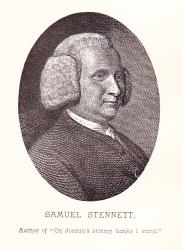
Samuel Stennett (1727–1795) was one of the most distinguished English Baptist ministers of the eighteenth century, a respected champion of religious liberty, and a gifted hymnist whose verses became bedrock anthems for Protestant congregations across Great Britain and America. Born in Exeter in 1727, Stennett inherited a rich spiritual and literary lineage; both his grandfather, Joseph Stennett, and his father, Dr. Joseph Stennett, were prominent Baptist pastors and hymn writers. When his father assumed the pastorate of the Particular Baptist church in Little Wild Street, London, young Samuel moved with the family to the capital. He became his father’s ministerial assistant in 1748 and, upon his father's death in 1758, succeeded him as senior pastor—a highly influential pulpit he would occupy with great distinction for thirty-seven years.
Stennett quickly rose to become a central figure among London's Dissenting ministers. Celebrated for his refinement, intellectual depth, and warm pastoral heart, he earned the respect of numerous high-profile figures and statesmen, using his social standing to advocate zealously for the political and religious rights of Nonconformists. The famous prison reformer John Howard was a devoted member of Stennett's congregation and a close personal friend. In recognition of his theological expertise and scholarship, King's College, University of Aberdeen, conferred upon him the degree of Doctor of Divinity in 1763.
While Stennett published several volumes of prose sermons and treatises on religious freedom, his most enduring legacy rests on his sacred poetry. In 1787, he contributed thirty-eight original hymns to the landmark collection A Selection of Hymns from the Best Authors, compiled by his close friend Dr. John Rippon. Though contemporary critics sometimes noted that his verse lacked the raw, muscular vigor of his grandfather's poetry, his hymns were widely praised for their polished expression, theological clarity, and tender, evocative sentiment.
Stennett’s compositions became wildly popular, particularly in American frontier camp meetings and Baptist hymnals, where many were paired with stirring folk melodies. Among his thirty-eight published pieces, several remain defining classics of Christian hymnody:
-
"On Jordan's stormy banks I stand" – His most celebrated masterpiece; a triumphant, eschatological song longing for heaven (Canaan's fair land) that became a cornerstone of early American folk-hymn traditions.
-
"Majestic sweetness sits enthroned" – Taken from his larger text "To Christ, the Lord, let every tongue," this deeply beloved stanza captures the beauty and grace of Christ’s ministry.
-
"How charming is the place" – A tender and joyful hymn celebrating the beauty of corporate, public worship.
-
"Prostrate, dear Jesus, at Thy feet" – A deeply moving, penitential text frequently utilized as a standard Lenten confession.
-
"Here at Thy Table, Lord, we meet" – A solemn, widely used text composed specifically for the ordinance of Holy Communion.
Dr. Stennett ministered faithfully at Little Wild Street until his death on August 24, 1795. His collective works, paired with an authoritative memoir by W.J. Jones, were later compiled into a definitive four-volume collection in 1824, solidifying his stature as a towering figure of the golden age of English hymnody.