About St, Patrick
Patrick, Saint (c. 372–c. 466)
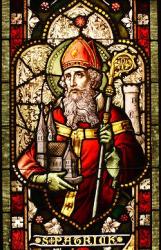
Saint Patrick, the celebrated apostle, bishop, and patron saint of Ireland, was born in North Britain (most likely near Dumbarton, Scotland) around 372. Though famously associated with Ireland, Patrick was born into a Roman-British family of high civic and ecclesiastical standing; his father, Calpurnius, was a deacon and a decurio (a Roman local town councilman), his grandfather Potitus was a priest, and his mother Concessa is traditionally said to have been related to St. Martin of Tours.
At the age of sixteen, Patrick’s comfortable life was shattered when he was captured by Irish raiders and carried off into slavery. For six years, he endured harsh isolation while tending livestock on the slopes of Mount Slemish in County Antrim. During this grueling captivity, his childhood faith underwent a profound conversion. He turned intensely to prayer and mastered the Irish language—a tool that would later reshape the religious history of the island.
After escaping his captors and returning to his family, Patrick was stirred by vivid spiritual visions urging him to return to the land of his captivity. He underwent theological training in Gaul (modern France), where he was ordained as a deacon, priest, and eventually bishop. Around 425, he launched his independent missionary campaign to Ireland. Operating without a direct papal mandate from Rome, Patrick focused on converting the pagan Gaelic tribes and challenging the deep-rooted influence of the local druids. His historic mission proved extraordinarily successful, establishing a vibrant, uniquely organized Celtic Christian church that would preserve learning through the Dark Ages.
"The Breastplate of Saint Patrick" (Lorica)
Within hymnology, Saint Patrick’s name is permanently linked to one of the oldest and most powerful monuments of Christian song: the "Breastplate of Saint Patrick" (historically known as the Lorica or Canticum Scotticum).
Origin and Tradition
According to ancient Irish tradition preserved in the Liber Hymnorum (a manuscript dating back to the 9th–12th century), Patrick composed and chanted this protective incantation on Easter Sunday. He was proceeding with his followers to encounter the druidical fire-worshippers and pagan King Laoghaire at the royal hill of Tara. As they walked through the woods, the king's ambushers reportedly saw only a herd of wild deer passing by, allowing the missionaries to escape harm.
While modern historians debate whether Patrick penned the exact surviving Irish text, hymnologists note that the poem contains archaic, pre-Roman Celtic theology. It lacks references to later medieval miracles, relies heavily on the early phrase "Creator of Doom" (meaning Judge), and mirrors the immediate spiritual warfare of a 5th-century frontier mission. In 690, Tirechan’s Collections mandated that this "Irish Hymn" be sung in every monastery and church across Ireland.
The Path to Modern Hymnals
The complex, 78-line original Old Irish text underwent several major literary transitions before entering modern congregational worship:
Discovery & First Translation
1839
Antiquarian Dr. George Petrie discovers the original Old Irish text in the Liber Hymnorum at Trinity College, Dublin, publishing it with an unrhymed English translation.
The Stokes-Todd Academic Translation
1857–1864
Celtic scholar Dr. Whitley Stokes provides the first linguistically accurate translation of the Lorica, which Dr. James Henthorn Todd later introduces to the wider academic public.
The Metrical Paraphrase by Mrs. Alexander
1889
Mrs. Cecil Frances Alexander writes a magnificent, rhymed metrical version of the text for St. Patrick's Day. Her version successfully captures the sweeping, rhythmic power of the original Irish phrasing.
The Enduring Text
Mrs. Alexander's 1889 version, "I bind unto myself today," seamlessly fused the ancient Celtic concept of a lorica (a prayer buckled on like armor) with standard English hymn meters. Set to the traditional Irish melodies ST. PATRICK and DEIRDRE, it remains a monumental anthem across global Christianity, sung during Trinity Sunday, ordinations, and festivals.
I Bind Unto Myself Today
I bind unto myself today The strong Name of the Trinity, By invocation of the same, The Three in One, and One in Three.
I bind this day to me forever, By power of faith, Christ’s Incarnation; His baptism in Jordan river; His death on Cross for my salvation; His bursting from the spiced tomb; His riding up the heavenly way; His coming at the day of doom; I bind unto myself today.
The hymn climaxes with an intimate, defensive rhythmic stanza that has become one of the most beloved personal prayers in the English language:
Christ with me, Christ before me, Christ behind me, Christ in me, Christ beneath me, Christ above me, Christ on my right, Christ on my left, Christ when I lie down, Christ when I sit down, Christ when I arise...
Saint Patrick passed away on March 17 (c. 466), a date now celebrated globally. Through his historic autobiography, the Confession, and the raw, protective verse of the Breastplate, his legacy survives not as a mythical figure of folklore, but as a deeply dedicated, resilient missionary who bound his life unreservedly to the sovereign power of God.