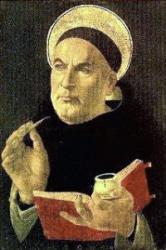
About Thomas Aquinas
Saint Thomas Aquinas (c. 1225–1274), known as the "Angelical Doctor" (Doctor Angelicus), was a Dominican friar, philosopher, jurist, and theologian who stands as the towering intellectual giant of the medieval Scholastic tradition. Canonized as a Doctor of the Church, his integration of Aristotelian philosophy with Christian theology permanently reshaped Western thought. While universally celebrated for his monumental prose masterwork, the Summa Theologiae, Aquinas was also a deeply mystical poet whose small corpus of Latin eucharistic hymns remains a cornerstone of global liturgy.
Early Resistance and the Dominican Vow
Thomas was born of noble lineage in the castle of Roccasecca near Aquino, Italy. His father was Landulph, Count of Aquino, and his mother, Theodora, was a wealthy Neapolitan noblewoman. At just five years old, he was sent to the historic Benedictine monastery at Monte Cassino for his early schooling. When military conflict forced his departure, he enrolled at the University of Naples, where he first encountered the newly formed Dominican Order (the Order of Preachers).
Attracted to their lifestyle of poverty, academic rigor, and itinerant preaching, a seventeen-year-old Thomas resolved to join them. This choice horrified his aristocratic family, who expected him to become a wealthy high-ranking Benedictine abbot. To stop him, his brothers kidnapped him on the road to Paris, dragging him back to the family fortress where they imprisoned him for over two years.
During this confinement, his brothers went so far as to send a courtesan into his cell to break his vow of celibacy. Thomas famously drove her out with a branding iron from the fire and used the charred wood to draw a cross on his wall. Realizing his resolve was unbreakable, his family eventually relented, allowing him to escape through a window to rejoin his Dominican brothers.
Academic Ascendancy and State Influence
Once freed, Thomas studied in Paris and Cologne under Albertus Magnus, another legendary medieval polymath. In the classroom, Thomas's quiet, heavy frame earned him the cruel nickname "The Dumb Ox." Albertus famously silenced the class by declaring:
"We call this young man a dumb ox, but his bellowing in doctrine will one day resound throughout the whole world."
Thomas quickly rose to become a master professor of theology at the University of Paris and across major Italian universities. His intellectual influence was so profound that King Louis IX of France made Thomas a member of his Council of State, routinely sending delicate political and ethical questions to the friar's cell the night before a council meeting so Thomas could reflect on them in solitude.
Despite receiving constant offers from popes to become a Cardinal or the Archbishop of Naples, Thomas steadfastly refused all ecclesial honors, preferring the simple life of a writing friar.
The Great Eucharistic Hymns (1264)
In 1264, Pope Urban IV instituted the global feast of Corpus Christi and commissioned Thomas Aquinas to single-handedly compose the entire liturgical office for the day—including the prayers, lessons, and hymns.
Thomas responded by writing five Latin hymns that are considered absolute masterpieces of sacred poetry. Using a brilliant literary technique, Thomas managed to condense incredibly complex, abstract theological frameworks regarding the Lord's Supper into beautifully rhythmic, metric verse that common people could easily memorize and sing.
                     ┌──────────────────────────────────────┐
                     │    THOMAS AQUINAS' CORPUS CHRISTI    │
                     └──────────────────┬──────────────────┘
                                        │
         ┌──────────────────────────────┼──────────────────────────────┐
         ▼                              ▼                              ▼
 PANGE LINGUA                    LAUDA SION                     ADORO TE DEVOTE
Celebrates the institution     The poetic Sequence for the     A deeply intimate, private
of the Eucharist; contains     Mass; known for its dogmatic   prayer of adoration and personal
the 'Tantum Ergo' stanza.      precision and rhythmic energy.  spiritual surrender.
The Definitive Liturgical Corpus
-
Pange lingua gloriosi Corporis Mysterium – A majestic narrative hymn tracing the incarnation and the Last Supper. The final two stanzas, starting with "Tantum ergo Sacramentum," became the definitive universal anthem used during Eucharistic Benediction across the globe.
-
Lauda Sion Salvatorem – The formal Sequence for the Mass, praised by linguists for its intricate rhyme scheme and its ability to state complex doctrinal definitions without losing its poetic beauty.
-
Adoro te devote latens Deitas (Humbly I Adore Thee) – A deeply personal, contemplative prayer focusing on the hidden presence of God, later translated into a celebrated English hymn by the Anglican poet Gerard Manley Hopkins.
-
Sacris sollemniis juncta sint gaudia – A sweeping festal hymn. Its final section contains the "Panis Angelicus" (Bread of Angels), which was later immortalized in classical music settings by composers like César Franck.
-
Verbum supernum prodiens – A poignant hymn tracking Christ’s journey to the cross, containing the famous stanza O Salutaris Hostia, used universally for exposition of the sacrament.
| Original Latin Title | Common English Translation | Primary Modern Liturgical Use |
|---|---|---|
| Pange lingua | Sing, My Tongue, the Savior's Glory | Maundy Thursday & Benediction |
| Adoro te devote | Humbly I Adore Thee, Hidden Deity | Communion Meditations |
| Sacris sollemniis | At This Our Solemn Feast | Processionals (Panis Angelicus) |
| Verbum supernum | The Heavenly Word Proceeding Forth | Altar Devotions (O Salutaris) |
The Ultimate Silence and Legacy
On December 6, 1273, while celebrating Mass in Naples, Thomas experienced a profound, mystical vision that shook him to his core. Afterward, he abruptly dropped his pen and refused to write another word, leaving his lifelong masterpiece, the Summa Theologiae, incomplete. When his secretary, Reginald of Piperno, begged him to return to his work, Thomas replied:
"I can do no more. Such secrets have been revealed to me that all I have written now appears to me as so much straw."
A few months later, while traveling on a mule to attend the Second Council of Lyons, Thomas fell ill. He was taken into the Benedictine Abbey of Fossa Nuova, where he passed away peacefully on March 7, 1274, at approximately forty-eight years of age.
At the later 16th-century Council of Trent, the bishops honored his staggering intellectual legacy by placing his Summa Theologiae directly on the high altar, second in position only to the Holy Scriptures, a monument to a thinker who successfully married the sharpest peaks of human reason with the deepest wells of poetic adoration.
From the Dictionary of Hymnology
Related terms and topics automatically matched to this author.
Adoro Te devote, latens Deitas History
Detailed history of St. Thomas Aquinas's famous Eucharistic hymn "Adoro Te devote," tracing its origins, liturgical use, manuscript traditions, and numerous English translations.
Read more