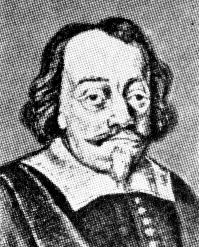
About Valentin Thilo
Valentin Thilo. Source: Wikidata
Valentin Thilo (1607–1662) was a noted German theologian, professor of rhetoric, and hymnwriter of the Baroque era. Born in Königsberg, East Prussia, on April 19, 1607, he was the son of Valentin Thilo the elder, a church deacon who died of the pestilence in 1620. The younger Thilo matriculated at the University of Königsberg in 1624 to study theology but quickly found his true academic calling in classical rhetoric. When his professor, Samuel Fuchs, retired in 1632, Thilo was recommended as his successor. To prepare for the prestigious chair, Thilo spent two years advancing his studies at the University of Leyden in the Netherlands. Upon returning to Königsberg, he graduated with his Master of Arts in 1634 and was formally installed as Professor of Rhetoric. Over a distinguished twenty-eight-year academic career, he was elected five times as dean of the Philosophical Faculty and twice served as Rector of the University before his death on July 27, 1662.
Beyond his university responsibilities, Thilo was a central figure in the vibrant cultural life of seventeenth-century East Prussia. He was a close lifelong friend of the composer Heinrich Albert and the celebrated poet Simon Dach, joining them as an active member of the famous Königsberg Poetical Union (Königsberger Dichterkreis). Aside from publishing two foundational text books on rhetoric in 1635 and 1647, Thilo composed numerous sacred hymns. His pieces, written primarily for the major festivals of the Christian liturgical year, were characterized by their concise structure and vigorous expression. The majority of his musical works were published in the Preussische Fest-Lieder (1642–1644) and the New Preussisches vollständiges Gesang-Buch (1650). Although historic collections occasionally confused his hymnody with that of his father, later nineteenth-century textual analysis firmly established the younger Thilo as the sole author.
Thilo's most enduring international legacy rests upon his fine Advent hymn, "Mit Ernst, o Menschenkinder" ("Ye sons of men, in earnest"), which was based on the biblical preparation narrative in Luke 3:4–5. First published in the 1842 edition of the Preussische Fest-Lieder, the four-stanza piece carries a poignant undertone; hymnologists note that its deeply reflective third stanza was likely written in memory of Thilo's beloved sister, who had succumbed to the plague in 1639. The hymn achieved a broad reaching impact within the English-speaking world during the mid-nineteenth century through well-received translations by Arthur Tozer Russell in 1851 and Catherine Winkworth in her renowned Chorale Book for England (1863), preserving Thilo's voice within traditional Lutheran and Protestant collections for centuries to come.