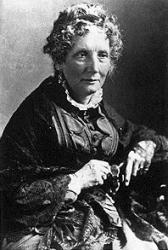
About Harriet Beecher Stowe
Harriet Beecher Stowe (1811–1896) was a monumental figure in American history and literature, whose influence as an author was matched by a deep, introspective faith. Born in Litchfield, Connecticut, she was a member of the prominent Beecher family, known for their social activism and religious leadership. While she achieved global fame with the 1852 publication of Uncle Tom's Cabin, a work that significantly shaped public opinion against slavery, she also maintained a lifelong commitment to devotional poetry and hymnody. Her marriage to Professor Calvin E. Stowe and her upbringing as the daughter of Reverend Lyman Beecher rooted her work in a tradition of intellectual and spiritual inquiry.
Stowe's hymns are celebrated for their contemplative and serene nature, often focusing on the internal peace found through divine communion. Three of her most enduring hymns were first introduced to the public in the Plymouth Collection (1855), which was edited by her brother, the famed preacher Henry Ward Beecher. These include:
-
"Still, still with Thee, when purple morning breaketh": Widely considered her finest hymn, it uses the quiet of the dawn as a metaphor for the soul's morning fellowship with God.
-
"When winds are raging o'er the upper ocean": A poetic exploration of the "peace that passeth all understanding," comparing the soul's depth to the calm waters beneath a storm-tossed sea.
-
"That mystic word of Thine, O sovereign Lord": A meditation on the concept of abiding in Christ.
In 1867, she published Religious Poems, a collection that further established her as a voice of spiritual sensitivity. From this volume, the popular hymn "Knocking, knocking, who is there?" was adapted, gaining widespread use through the revival services of Ira D. Sankey. Unlike the fiery oratory often associated with her family, Stowe's hymns offered a "quietism" that emphasized resting in God and the presence of the Savior in the midst of life's struggles. Her legacy remains a unique blend of powerful social justice advocacy and a gentle, poetic mysticism that continues to provide comfort to congregations worldwide.