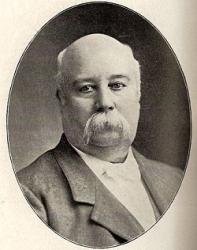
About Henry L. Gilmour
Henry Lake Gilmour (1836–1920) lived a life defined by dramatic transitions—from a teenage Irish immigrant to a Civil War prisoner, and finally to a beloved dentist and pillar of the American camp meeting movement. Born in Londonderry, Ireland, he emigrated to the United States with dreams of studying navigation but instead found himself working as a painter in Philadelphia. His life took a harrowing turn during the American Civil War, where he was captured and held as a prisoner of war in the notorious Libby Prison in Richmond, Virginia.
Following the war, Gilmour pivoted to a career in dentistry, practicing for many years in Wenonah, New Jersey. However, his true passion lay in the rhythmic, soulful music of the Methodist "Holiness" tradition. For forty years, he was the heart of the Pitman Grove Camp Meeting, where he directed the choir and led thousands in song. His dental office was often a place where melodies were hummed as much as teeth were tended, and he became a sought-after song leader for major revival gatherings across Maryland and Pennsylvania.
Gilmour was a massive force in the publishing world of gospel music. He edited or published at least 25 songbooks, collaborating with the era's most famous composers, including William J. Kirkpatrick and John Sweney. While he was a capable lyricist, he was primarily celebrated as a composer who could turn a simple testimony into a stirring, unforgettable tune. His most famous musical composition is the melody for "The Haven of Rest," written in 1889 to lyrics by H.L. Duffield. The song’s nautical imagery—"My soul in sad exile was out on life’s sea"—resonated deeply with Gilmour’s own early dreams of seafaring and his spiritual journey.
In addition to his solo work, Gilmour was the musical engine behind many of the hymns written by Henry J. Zelley, including the high-energy classic "He Brought Me Out." His music was characterized by a bright, hopeful quality that defined the "Golden Age" of the gospel song. Tragically, Gilmour's long and productive life came to an end in 1920 following a buggy accident in Delair, New Jersey. He left behind a legacy of music that continues to be sung by those seeking a "haven" in their spiritual lives.